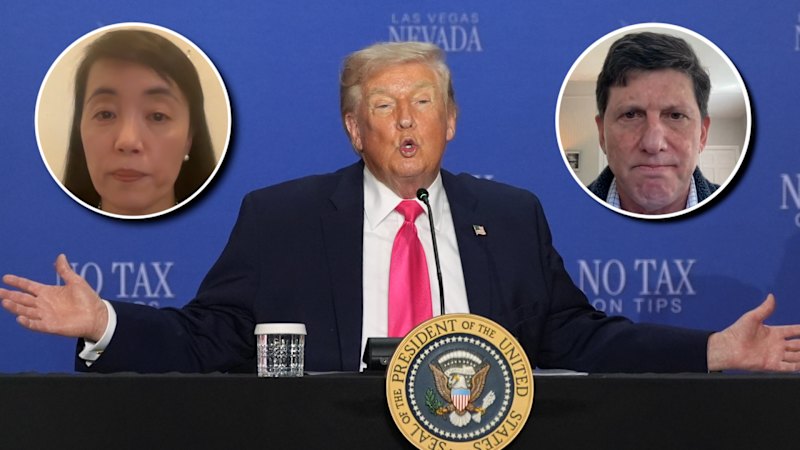
New York and a coalition of blue-state attorneys general are finalizing a legal offensive to dismantle the White House’s latest tariff regime before the first shipping containers hit the docks. This is not a standard policy disagreement or a typical trade dispute. It is an existential challenge to executive power. The states argue that the administration is using national security justifications as a pretext to bypass Congress, effectively seizing the "power of the purse" and the authority to regulate foreign commerce—duties explicitly granted to the legislative branch under Article I of the Constitution.
While the administration frames these broad import duties as a tool for economic revitalization, the looming lawsuits suggest a different reality. The legal strategy hinges on the theory that these tariffs represent an unconstitutional "end run" around the Supreme Court’s recent rulings, which have tightened the leash on federal agencies. If the courts agree, the entire architecture of modern trade policy could be dismantled in months.
The Ghost of the Non-Delegation Doctrine
For decades, presidents have used the Trade Expansion Act of 1962 and the International Emergency Economic Powers Act (IEEPA) as a blank check. Section 232 of the 1962 Act allows for tariffs if an import "threatens to impair the national security." In the past, this meant protecting steel for tanks or microchips for missiles. Now, the definition has been stretched to include virtually every consumer good entering the country.
The New York-led coalition is betting that the current Supreme Court is tired of this stretch. The justices have recently signaled a desire to revive the non-delegation doctrine, a legal principle that prevents Congress from handing over its core powers to the President without very specific "intelligible principles" to guide them. By applying tariffs to every country and nearly every product category, the administration may have finally crossed the line from "executing law" to "making law."
Legal experts involved in the drafting of the lawsuits indicate that the primary target is the lack of a clear nexus between a pair of sneakers or a toaster and the actual defense of the United States. If everything is national security, then nothing is. That logic is the soft underbelly of the administration's trade strategy.
The Economic Shrapnel in the Supply Chain
While the lawyers argue over constitutional theory, the business community is bracing for the impact. This isn't just about higher prices at the grocery store. It’s about the disintegration of just-in-time manufacturing.
Consider a mid-sized electronics firm in upstate New York. They don’t just buy finished goods; they import specialized components that are integrated into American-made products. A 25% blanket tariff doesn't just eat their margin—it renders their entire business model obsolete overnight. These companies cannot simply "move the factory" in a fiscal quarter.
The states are using these concrete economic harms to establish standing. To sue the federal government, a state must prove it has been directly injured. New York, California, and Illinois are preparing mountains of data showing how these tariffs will shrink their tax bases, increase unemployment filings, and force state-funded infrastructure projects to go hundreds of millions of dollars over budget due to the rising cost of raw materials.
The Pretext Problem
The administration’s internal memos frequently cite "economic security" as synonymous with "national security." This is the pivot point for the litigation. The plaintiffs will argue that the administration is using Section 232 as a "workaround" because they know they cannot get a divided Congress to pass a traditional tax hike or a specific trade bill.
The Supreme Court’s decision in Loper Bright, which ended the era of Chevron deference, means that courts no longer have to take a federal agency's word for it. In the past, the Department of Commerce could simply say "this is a security issue," and the courts would nod along. Not anymore. Now, the government must prove its case with evidence that can withstand a skeptical judge's scrutiny.
A Tax by Another Name
We need to call these tariffs what they actually are: a massive, regressive tax on the American public that never received a single vote in the House of Representatives.
The irony of the current situation is that the very states led by the President’s harshest critics are the ones defending the traditional, conservative reading of the Constitution. They are demanding that the "people’s branch"—Congress—reclaim its authority. This creates a strange political alignment where progressive attorneys general are quoting originalist legal theories to stop an executive overreach.
The Retail Breaking Point
Retailers are already looking at the math, and it is grim. For a typical retail business with a 5% to 10% profit margin, a 20% tariff is a death sentence if they don't pass it on. But passing it on isn't a guarantee of survival; it’s a gamble on consumer resilience.
- Inventory Front-loading: Companies are burning through cash to bring in goods before the lawsuits hit or the tariffs go live. This creates a temporary "fake" boom in port activity followed by a massive slump.
- Credit Contractions: Banks are reassessing the risk profiles of importers. If your cost of goods suddenly jumps 25%, your creditworthiness drops.
- Substitution Failure: The idea that these tariffs will immediately spark a domestic manufacturing renaissance is a fantasy. It takes years, if not decades, to build the specialized labor pools and machinery required to replace global supply chains.
The Judicial Wildcard
The fate of the global economy now sits in the hands of a few federal judges in the D.C. Circuit and, eventually, the nine justices in Washington. If the states secure a preliminary injunction, the tariffs will be frozen. This would create a period of extreme volatility. Would the administration respect the freeze, or would they attempt to bypass the courts again by declaring a full-scale national emergency?
The legal theory of "Major Questions" will likely play a role here. The Supreme Court has ruled that if an agency wants to do something of "vast economic and political significance," it must have clear, specific authorization from Congress. A global trade war involving trillions of dollars clearly fits that description. Since the 1962 Act doesn't explicitly authorize a total decoupling from the world economy, the states have a very strong hand to play.
The Cost of the Fight
This isn't a "free" legal battle. Even if the states win, the uncertainty alone acts as a hidden tax. Business hates nothing more than a variable they cannot quantify. Until this is settled, every investment in American expansion is on hold.
The administration argues that they are protecting the American worker, but the states will argue that you cannot protect a worker by destroying the purchasing power of their paycheck. It is a collision between populist industrial policy and the cold, hard reality of constitutional limits.
The coming months will determine if the presidency has truly become an elective kingship over the economy, or if the system of checks and balances still has teeth. The states are betting on the latter. They are betting that the law is more powerful than the tweet.
If the courts rule that these tariffs are an illegal end run, it won't just be a defeat for the current administration. It will be a total restructuring of how the United States interacts with the rest of the planet. We are looking at the potential end of executive-led trade policy. The era of the "Imperial President" in trade is facing its most dangerous challenge in a century.
The first filings are expected in the Southern District of New York. Every CEO, every consumer, and every foreign trade minister should be reading the fine print.