The air in Brampton during a February cold snap doesn't just sit; it bites. It is a wet, heavy cold that finds the gaps in your thermal layers and settles into your joints. For those living in the sprawl of the Greater Toronto Area, the sound of winter isn’t a silent snowfall. It is the rhythmic, metallic scrape of plastic shovels hitting asphalt, the rhythmic grunt of neighbors battling an accumulation that seems to grow faster than they can move it.
Then, a new sound cut through the suburban morning. It wasn't the high-pitched whine of a two-stage snowblower or the low rumble of a plow. It was the frantic, mechanical cough of a summer ghost: a lawnmower.
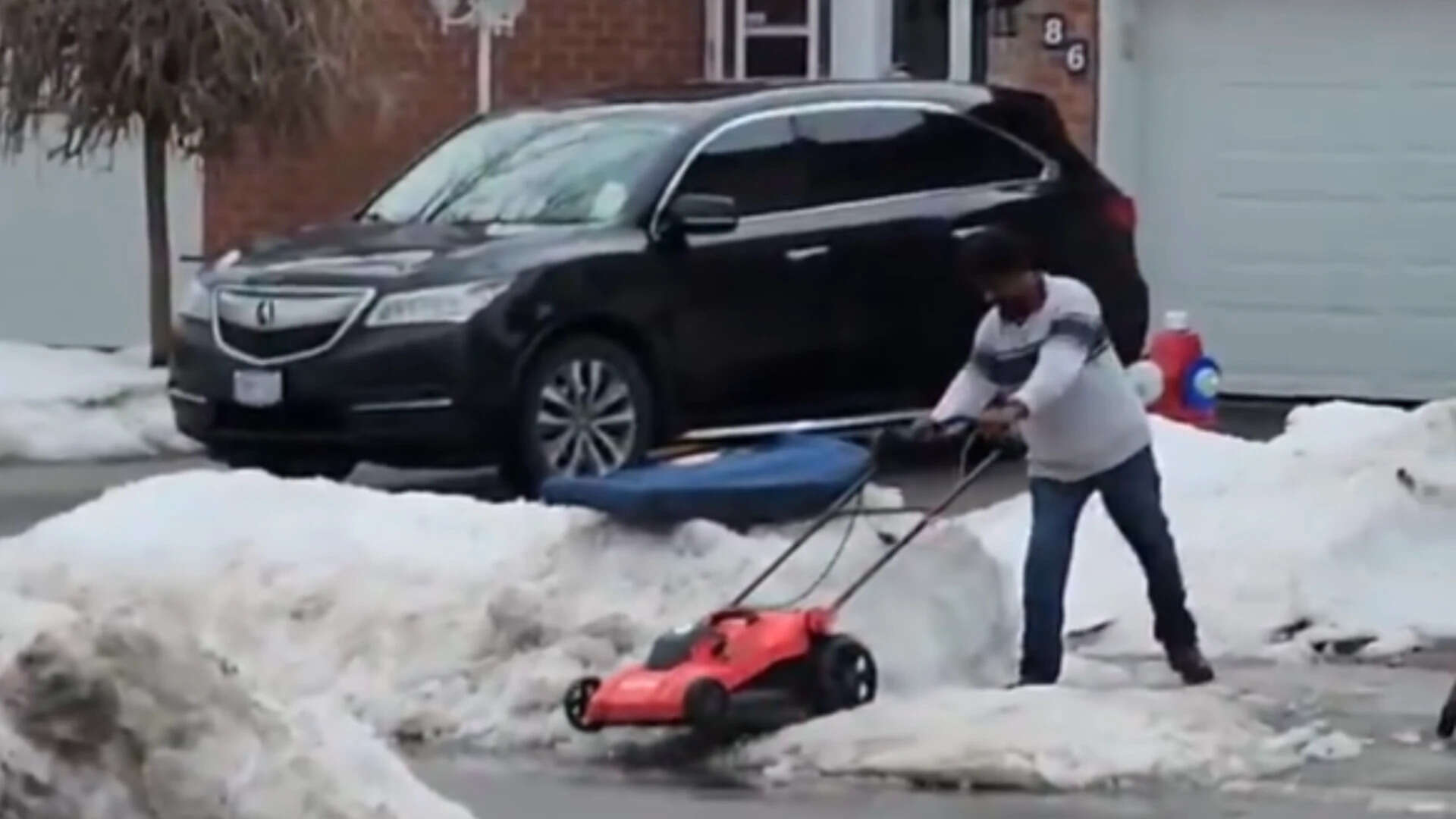
In a video that racked up millions of views across social media, a man is seen pushing a standard rotary mower through several inches of heavy, white powder. The internet did what the internet does. The comments sections became a digital Coliseum, filled with spectators tossing down "thumbs down" icons and mocking the man's intelligence. They called him "not the best and brightest." They laughed at the absurdity of using a blade designed for soft Kentucky bluegrass to tackle frozen precipitation.
But if you look past the blurred pixels of the viral clip, you see something more than a mechanical error. You see a portrait of suburban breaking point.
The Anatomy of a Bad Idea
To understand why someone would pull the starter cord on a lawnmower in minus-ten-degree weather, you have to understand the physics of the "snow day" in a commuter city. When the flakes start falling in Brampton, a clock starts ticking. There is a window of time—usually about three hours—before the snow settles, compacts, and becomes a concrete-like barrier between your car and your livelihood.
Standard snow removal equipment is expensive. A decent snowblower can cost upwards of eight hundred dollars, a steep price for a machine that sits dormant for eight months of the year. Shoveling, while free, is a cardiovascular gauntlet. Every year, Canadian hospitals see a spike in cardiac events related to snow removal. The "heavy lift and twist" motion is a notorious killer.
Enter the lawnmower. On paper, or perhaps in a mind clouded by exhaustion and the pressure of a 7:00 AM shift, the logic holds a fragile sort of weight. A mower has a spinning blade. Snow is just frozen water. Surely, the centrifugal force will discharge the snow just like it discharges grass clippings?
The reality is a messy lesson in thermodynamics. A lawnmower works by creating lift. The blade is shaped to pull grass upward so it can be sliced cleanly. Snow, however, is dense. It doesn’t lift; it clogs. Within seconds, the underside of the mower deck becomes a frozen slush-box. The engine strains, the belt slips, and the "solution" becomes a twenty-pound paperweight stuck in the middle of the driveway.
The Invisible Stakes of the Driveway
We laugh at the man in the video because it’s easier than acknowledging the frantic pressure that put him there. Modern life in the suburbs is built on a precarious foundation of mobility. If you cannot clear your driveway, you cannot get to the GO station. If you cannot get to the station, you are late for the office in downtown Toronto. In an economy that feels increasingly volatile, being the person who "can't make it in because of weather" feels like a professional death sentence.
Consider a hypothetical resident—let’s call him Amandeep. He works two jobs. He has a mortgage that adjusted upward last year, eating into his emergency fund. He wakes up to find ten centimeters of the "white stuff" blocking his path. His shovel broke last winter. The local hardware store is sold out of replacements. He looks in his garage and sees the mower.
It is a moment of pure, unadulterated "MacGyverism" born of necessity. It is the human spirit attempting to bend an unsuitable tool to its will because the alternative—failure, lost wages, a boss’s scowl—is unacceptable.
The mockery directed at the Brampton mower-man misses this emotional core. We aren't watching a lack of IQ; we are watching a lack of options. We are witnessing the moment when the friction of daily life becomes so high that the machinery of our common sense starts to smoke.
A Lesson in Mechanical Empathy
There is a technical reason why this viral moment resonated so deeply, beyond the slapstick visual of it. It highlights our widening gap in mechanical literacy. A generation or two ago, the internal combustion engine was a neighborly language. Most people understood the difference between a high-torque auger and a high-speed finishing blade.
Today, we treat our tools like magic wands. We expect them to work because we pressed the "on" button, regardless of the environment. When they fail, or when we use them incorrectly, the failure is broadcasted to the world as a character flaw.
But look at the man in the video again. He is persistent. He is pushing that mower with a dogged determination that is almost heroic in its futility. He is cold, he is likely frustrated, and he knows he looks ridiculous. Yet, he continues. He is fighting the Canadian winter with the only weapon he has left in his arsenal.
The mechanics are simple:
- Air Intake: Snow blocks the air filter, choking the engine.
- Moisture: Melting snow hits a hot spark plug, causing a short.
- Density: The mower blade is designed for 25-gram grass stalks, not 50-kilogram slush drifts.
But the human element is complex. It is about the pride of homeownership, the desperation of the morning commute, and the strange, stubborn way we refuse to let nature win, even when we are clearly outmatched.
The Digital Pillory
The true "not the best and brightest" might not be the man with the mower, but the culture that finds joy in the struggle of a neighbor. We have traded the old suburban tradition of "helping a guy out with a spare shovel" for "filming a guy from behind a curtain for TikTok clout."
The viral nature of the clip turned a private moment of frustration into a public execution of dignity. It stripped away the context of the man's morning—perhaps he was sick, perhaps he was grieving, perhaps he was just incredibly tired—and replaced it with a punchline.
There is a quiet dignity in the struggle against the elements, even when that struggle is poorly executed. The man in Brampton was trying. In a world where it is increasingly easy to just give up and let the snow bury us, there is something almost poetic about the roar of a lawnmower in a blizzard. It is a defiant, if misguided, scream into the storm.
Next time the snow falls and you see someone doing something "stupid" to clear their path, look closer. You might see a reflection of the same pressures we all face. The tools might change, and the mistakes might be different, but the weight of the task remains the same for everyone.
The mower eventually sputtered and died, leaving the man in the silence of the falling snow, still trapped, still cold, but no longer alone in his frustration—because now, the whole world was watching. He stood there for a moment, hands on the handlebar, a solitary figure in a vast, white landscape, realizing that some storms simply cannot be mowed away.