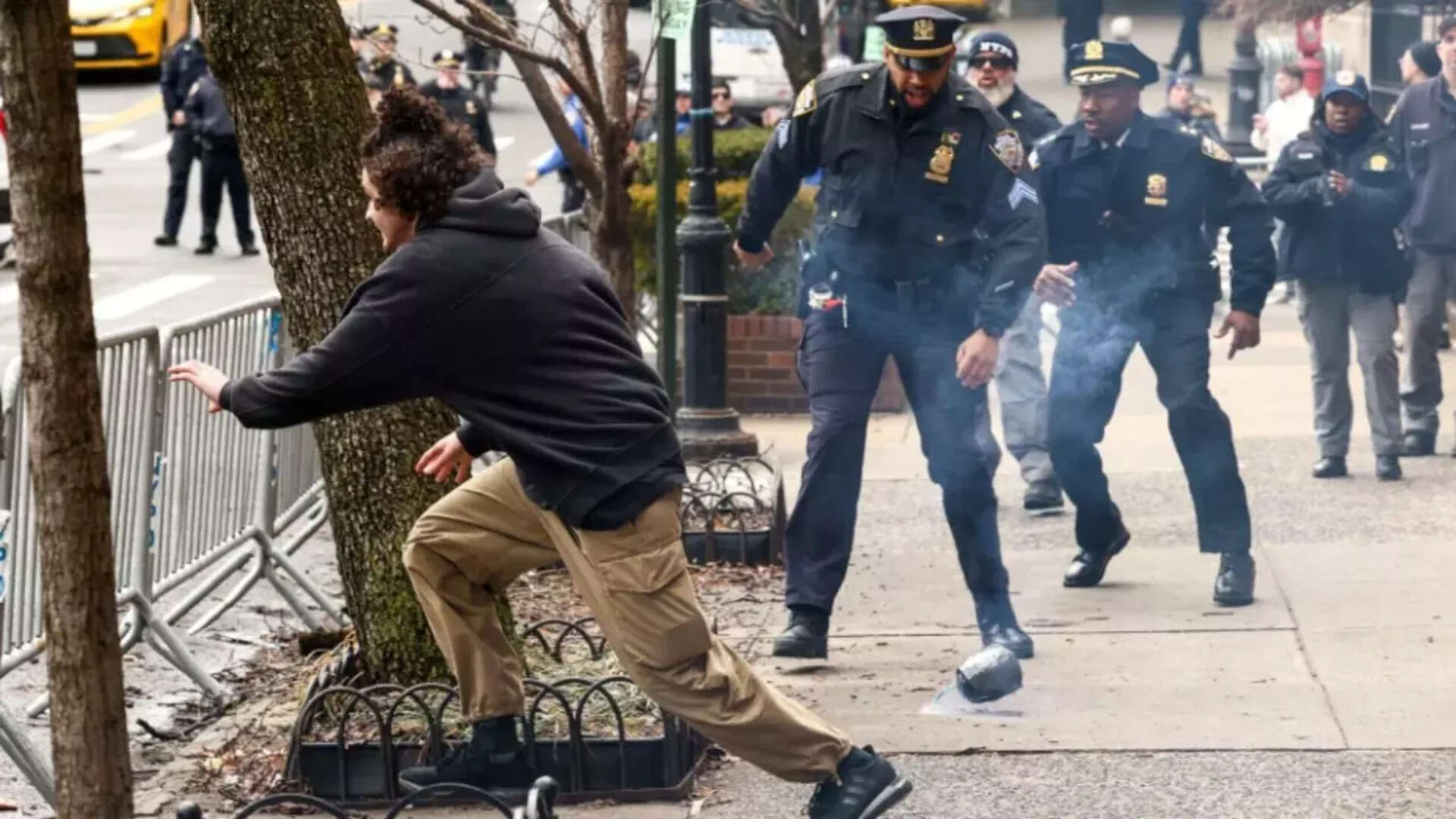
The detonation of an improvised explosive device (IED) outside the Upper East Side residence of New York City Mayor Ziad Mamdani marks a terrifying escalation in domestic political violence. What began as a volatile anti-Islam protest quickly spiraled into a federal investigation as a pipe-bomb style device was hurled toward the security perimeter of the mayoral mansion. This wasn't just a protest gone wrong. It was a targeted attempt to use lethal force to influence municipal policy, signaling a breakdown in the city's ability to contain radicalized fringes.
Security footage currently under review by the NYPD Intelligence Bureau and the FBI’s Joint Terrorism Task Force shows a masked individual weaving through a crowd of approximately 200 demonstrators before deploying the weapon. While the blast caused significant structural damage to a reinforced stone wall and shattered windows in two nearby vehicles, no fatalities were reported. The mayor and his family were inside at the time, sheltered in a secure basement Annex.
The Evolution of the Street IED
We are seeing a shift in the mechanics of urban unrest. For decades, New York City protests followed a predictable script: picket lines, chanted slogans, and the occasional scuffle with police. That script has been shredded. The use of an IED suggests a level of premeditation and technical skill that moves the conversation from "civil disobedience" to "domestic insurgency."
An improvised explosive device is defined by its lack of standard military manufacture, but don't let the "improvised" label fool you. The device used in this attack featured a sophisticated pressure-cooker mechanism similar to those seen in the 2013 Boston Marathon bombing. It contained a mix of low-grade explosive powder and ball bearings designed to maximize shrapnel spread.
The NYPD’s Bomb Squad has noted that the materials used—nitrate-based fertilizer and a digital timer—are easily accessible but require a specific knowledge base to assemble without self-detonating. This points toward a perpetrator who has spent time in extremist digital forums where these "cookbooks" are traded like currency.
Behind the Mansion Gates
Mayor Mamdani’s rise to power was fueled by a coalition of progressive activists and immigrant communities. His administration has been defined by a refusal to back down on controversial housing and religious freedom initiatives. This has made him a lightning rod for far-right groups who view his "Global New York" policy as a direct threat to national identity.
The protest outside his mansion was organized under the banner of "Protect the West," a loose-knit collective that has been gaining traction on encrypted messaging apps. Their grievance centered on the mayor’s recent approval of a large-scale Islamic cultural center in Lower Manhattan. However, the move from rhetorical opposition to high-explosive violence suggests the movement has been infiltrated or superseded by actors with more nihilistic goals.
City Hall sources indicate that the mayor had received three credible death threats in the week leading up to the bombing. Despite this, the security perimeter was breached. This raises uncomfortable questions about the NYPD’s protective details. How does a man with a bomb get within twenty feet of the mayor’s front door in one of the most heavily surveilled cities on earth?
The Intelligence Gap
The failure to intercept the device before it reached the mansion reveals a massive gap in "left-of-boom" intelligence gathering. The NYPD has one of the largest counter-terrorism budgets in the world, yet they were blindsided by a low-tech attack on their primary principal.
Historically, the department has focused on international threats or organized domestic groups with known hierarchies. The "lone wolf" or small-cell actor remains their greatest blind spot. These individuals often operate without a digital footprint that triggers traditional red flags. They don't buy large quantities of precursor chemicals at once. They don't post their manifestos on public platforms until after the fuse is lit.
The current surveillance apparatus is built to catch the many, but it is frequently bypassed by the dedicated few. We are looking at an era where the barrier to entry for domestic terrorism has dropped to the price of a hardware store shopping list and a steady internet connection.
Radicalization in the Concrete Jungle
To understand the blast, you have to understand the heat that produced it. New York is currently a pressure cooker of competing anxieties. Rising costs of living, a migrant crisis that has stretched social services to the breaking point, and a hyper-polarized media environment have created a fertile ground for radicalization.
The anti-Islam sentiment expressed by the protesters isn't happening in a vacuum. It is the result of a coordinated campaign of misinformation that paints municipal governance as a "soft-on-terror" regime. When political leaders or media figures use the language of "invasion" and "betrayal," they provide the moral justification for the man with the pipe bomb. He doesn't see himself as a criminal; he sees himself as a patriot clearing a path.
The Cost of Perimeter Failure
When a bomb goes off at a mayor’s house, the city pays twice. First, in the immediate damage and the psychological trauma to the citizenry. Second, in the inevitable "fortress" response that follows.
Expect to see the "Ring of Steel" around Gracie Mansion and the mayor's private residence expanded. This means more checkpoints, more invasive surveillance, and a further distancing of the elected leadership from the people they serve. It is a win for the attacker. The goal of terrorism is not just to kill; it is to force the state into a defensive, paranoid crouch that alienates the public.
If we look at the physics of the blast, the $P_{overpressure}$ (peak overpressure) generated by a device of this size is enough to rupture eardrums at thirty feet and cause structural failure in standard brickwork.
$$P_{overpressure} = \frac{808[1 + (\frac{Z}{4.5})^2]}{ \sqrt{1 + (\frac{Z}{0.048})^2} \cdot \sqrt{1 + (\frac{Z}{0.32})^2} \cdot \sqrt{1 + (\frac{Z}{1.35})^2} }$$
Where $Z$ is the scaled distance from the blast. This equation is used by forensic engineers to determine the weight of the explosive used based on the damage observed. In this case, the damage suggests a charge equivalent to roughly 2 pounds of TNT. That is a significant amount of energy to bring to a street protest.
The Political Fallout
The political repercussions will be immediate and ugly. Already, the mayor’s opponents are using the incident to claim his policies have made the city "lawless." Conversely, the mayor’s supporters are pointing to the blast as proof that white nationalist rhetoric is the primary threat to urban stability.
Neither side is entirely wrong, which is why the situation is so dangerous. We are losing the ability to have a shared set of facts. When an IED becomes a prop in a political argument, the incentive to prevent the next one diminishes. Both sides find the violence useful for their respective narratives.
A New Protocol for Urban Safety
The NYPD must now rethink its entire approach to crowd control and dignitary protection. The standard "bike rack" barricades are useless against a thrown projectile. We are likely to see the deployment of mobile X-ray units and chemical sniffers at every public gathering involving a high-ranking official.
This isn't just about the mayor. It’s about the precedent. If an attacker can get a bomb to the mansion, they can get one into a subway station, a library, or a school board meeting. The threshold for what constitutes a "high-risk" target has just been lowered.
We must also confront the reality of the "copycat" effect. Every successful or semi-successful attack provides a blueprint for the next person sitting in a basement with a grudge. The media coverage itself becomes a recruitment tool.
The investigation will likely produce an arrest within the week, given the density of cameras in NYC. But an arrest doesn't solve the underlying problem. The problem is a society that has become so fractured that high explosives are seen as a legitimate form of political speech.
We are no longer just fighting a security war; we are fighting a war of social cohesion. And right now, the explosives are winning.
Analyze the forensic trail of the explosives to see if they match any known domestic terror "signatures" currently on the FBI's watchlist.