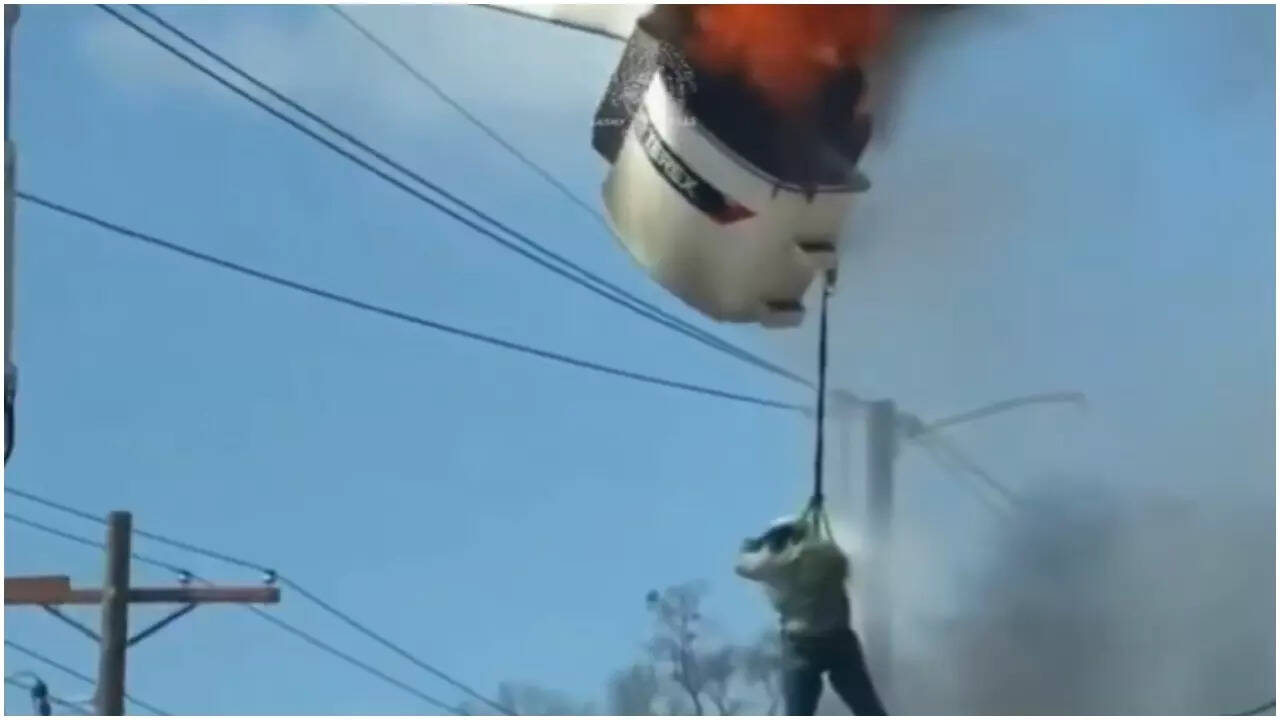
The footage is haunting. A man dangles from a bucket as orange flames lick the sky, eventually losing his grip and falling sixty feet onto the Louisiana pavement. The news cycle treats this like a freak act of God—a tragic, unavoidable glitch in the machinery of modern labor.
They are lying to you.
The "lazy consensus" surrounding industrial accidents suggests that if we just follow the manual and wear the harness, we are safe. This is a comforting myth designed to protect insurance premiums, not human lives. When a cherry picker turns into a vertical furnace, it isn't an "accident." It is a systemic failure of maintenance culture and a profound misunderstanding of how hydraulic systems actually die.
Stop looking at the fall. Start looking at the fire.
The Myth of the "Freak Accident"
Mainstream media loves the word "plunge." It’s visceral. It sells clicks. But calling a fall a "plunge" strips away the mechanical context. In the Louisiana incident, the worker was trapped because the very machine designed to keep him elevated became his executioner.
Most people assume these machines fail because of "old age." Wrong. Hydraulic lifts fail because of cavitation and thermal degradation that is ignored during "routine" inspections. I have seen safety officers sign off on equipment because the paint looked fresh while the hydraulic fluid was dark, oxidized, and essentially acting as a slow-motion bomb.
If your hydraulic fluid smells like burnt toast, the machine is already dead. It just hasn't stopped moving yet.
The Math of a Death Trap
Let’s look at the physics that the "thoughts and prayers" crowd ignores. A standard aerial work platform operates under immense pressure—often exceeding 3,000 PSI.
$$P = \frac{F}{A}$$
When a high-pressure line pinholes, it doesn't just leak; it atomizes. It creates a fine mist of flammable oil. Add a single spark from a frayed electrical wire or a hot manifold, and you don't have a mechanical failure. You have a blowtorch.
The worker didn't just fall. He was forced into an impossible choice between being cooked alive or testing the limits of gravity. The industry calls this "unforeseen." I call it a failure to respect fluid dynamics.
Why Your Safety Training Is Killing People
We spend billions on OSHA-compliant videos and fluorescent vests. We obsess over the "Point of Attachment" for harnesses. But here is the brutal truth: a harness is a secondary safety measure. It is the "plan B" that assumes "plan A" has already failed.
The industry has a fetish for PPE (Personal Protective Equipment) because it shifts the burden of safety onto the worker. If you fall, did you clip in? If you didn't, it’s your fault. This conveniently ignores the fact that the primary safety—the integrity of the machine—was compromised long before the worker stepped into the bucket.
The "Checklist" Delusion
Go to any construction site and look at the pre-start checklists. They are filled out with the same mindless repetition as a grocery list.
- Tires inflated? Check.
- Levels checked? Check.
- No visible leaks? Check.
"No visible leaks" is the most dangerous phrase in the English language for a technician. A pinhole leak at $20,000,000$ pascals is invisible to the naked eye until it’s too late. By the time you see the fluid, the pressure drop has already occurred, or the mist has already ignited.
Real safety isn't a checklist; it's predictive monitoring. If we aren't using ultrasonic leak detection and fluid analysis on every machine lifting a human being above twenty feet, we are just gambling with their lives and calling it "industry standard."
The Economics of Neglect
Why does this keep happening? Because maintenance is a "cost center" and uptime is a "profit center."
In the rental world—where many of these cherry pickers originate—the goal is to keep the machine "on rent" for as many days as possible. Every hour spent in the shop for a deep-dive hydraulic overhaul is an hour of lost revenue.
I’ve sat in boardrooms where "calculated risk" was used as a euphemism for "let’s see if we can get one more season out of those seals." It’s a game of Russian Roulette played with someone else’s spine.
The Low-Bidder Death Spiral
When a municipality or a contractor hires a firm for line work or maintenance, they often go with the lowest bidder. The lowest bidder stays the lowest bidder by cutting the one thing the client can't see: the quality of the maintenance program.
They use "will-fit" parts instead of OEM. They skip the expensive synthetic hydraulic oils that have higher flashpoints. They run the machines until they scream, then they patch them up and send them back out.
We are literally incentivizing companies to operate on the edge of catastrophe.
Dismantling the "People Also Ask" Nonsense
If you search for "cherry picker safety," you get a list of milquetoast questions. Let’s answer them with some actual honesty.
How do you survive a fall from a cherry picker?
You don't. At sixty feet, your terminal velocity ensures that the deceleration will liquefy your internal organs regardless of what you hit. The question shouldn't be how to survive the fall; it should be why the emergency descent system—a mandatory feature on these machines—failed to operate. Every lift has a manual bleed valve at the base. If that valve is seized or the fire is too intense to reach it, the "safety feature" is a decorative knob.
What is the safest type of aerial lift?
None of them. Safety is not a product feature; it is a state of rigorous, paranoid maintenance. A brand-new lift maintained by a lazy tech is more dangerous than a twenty-year-old rig maintained by a specialist who understands seal degradation.
Why did the machine catch fire?
Stop asking "why." Ask "when was the last time the electrical loom was inspected for chafing?" Fires in these units are almost always electrical-to-hydraulic chain reactions. A wire rubs against a frame, the insulation thins, a spark jumps, and the hydraulic mist provides the fuel.
The Counter-Intuitive Path Forward
If we want to stop seeing workers dangling from burning buckets, we have to burn down the current "safety" paradigm.
- Ban Manual Inspections as the Gold Standard: Humans are terrible at finding microscopic flaws. We need mandatory thermal imaging of all hydraulic lines under load every 100 hours of operation. If it’s glowing on the FLIR camera, the machine stays on the ground.
- Criminal Liability for Maintenance Logs: In the aviation industry, if you pencil-whip a logbook and a plane goes down, you go to prison. In the construction industry, you just get a fine that is lower than the cost of the repair you skipped. We need to treat a hydraulic lift with the same legal weight as a Boeing 737.
- Mandatory Fire Suppression: Why do we have fire suppression systems in race cars and server rooms but not in the engine compartments of machines that suspend humans in the air? It is a negligible cost that would have turned the Louisiana "horror" into a "minor inconvenience."
The Cold Truth
The worker in Louisiana is a casualty of a culture that values the "appearance" of safety over the "physics" of safety. We wear the hats, we sign the forms, and we pray the hoses hold.
It isn't enough to feel bad for the man in the video. You should be angry. You should be angry that we continue to use 1950s maintenance logic in a 2026 world.
Every time you see a cherry picker on the side of the road, don't look at the guy in the bucket. Look at the chassis. Look for the grime, the weeping seals, and the frayed wires. Because the man in the bucket isn't in control of his life—the guy with the wrench who decided to "save a few bucks" last Tuesday is.
Stop calling it a tragedy. Start calling it what it is: a predictable consequence of profitable negligence.
If you’re still relying on a daily walk-around to keep your people alive, you’ve already failed them.