The mountain air in Jammu and Kashmir carries a specific weight in late May. It is thick with the scent of pine needles baking under a high sun and the fine, metallic dust of the Himalayas. For those who live in the plains, this air is a promise of reprieve. They pack into buses with their bags full of light cotton clothes and their hearts set on the shrine at Shiv Khori, seeking a blessing or perhaps just a moment where the heat doesn't feel like an enemy.
They do not think about the physics of a twenty-two-seater carrying far more than twenty-two souls. They do not think about the age of the brake pads or the way the asphalt turns into a slick, treacherous ribbon where the mountain decides to push back against the road.
They only think about the destination. Until the road disappears.
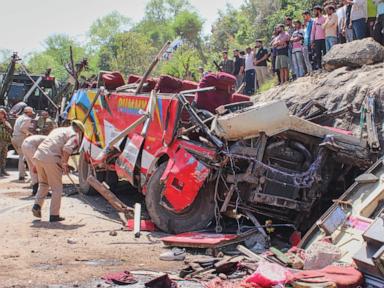
On a Thursday that should have been defined by the rhythmic chanting of pilgrims, the silence of the Tangli morh—a notorious hairpin bend in the Akhnoor sector—was shattered. A bus, carrying pilgrims from Haryana’s Kurukshetra, overshot the boundary of safety. It didn't just slide. It soared, momentarily and violently, before tumbling 150 feet into a deep, rocky gorge.
Twenty-one people died. Many more were left broken among the wreckage.
The Anatomy of a Descent
To understand why twenty-one lives vanished in a single afternoon, you have to understand the geography of neglect. The road from Jammu to Rajouri is not just a transit route; it is a test of nerves. The curves are sharp enough to make the stomach churn, and the drops are vertical enough to make the bravest traveler look away from the window.
Imagine a man named Satish. He is fictional, but he represents the twenty-one who are not. Satish saved for six months for this trip. He sat in the middle of the bus, wedged between his nephew and a cooler of water. He was laughing at a joke when the driver hit the Tangli bend.
In that split second, the mechanical reality of the bus met the unforgiving laws of gravity. Reports suggest the driver may have been speeding or perhaps lost control on the narrow stretch. When a vehicle of that mass loses its grip on a mountain pass, it ceases to be a machine. It becomes a projectile.
The fall is never silent. It is the sound of shearing metal, the glass shattering like ice under a hammer, and the terrifying, brief weightlessness before the first impact. For Satish, the world simply inverted. The blue sky was beneath him, and the grey rocks were above, and then there was nothing but the crushing weight of a journey cut short.
The Fragility of the Himalayan Arteries
This isn't an isolated tragedy. It is a recurring nightmare. The statistics of Jammu and Kashmir’s roads read like a casualty list from a low-intensity war. Over the last decade, thousands have perished in these gorges. We call them "accidents," a word that implies a stroke of cosmic bad luck, a lightning strike of fate.
But is it an accident when the infrastructure fails to keep pace with the volume of souls it must carry?
The Akhnoor road is a lifeline, yet it is frayed. When twenty-one people die, the news cycle treats it as a data point. A headline. A crawl at the bottom of a television screen. But for the families in Haryana waiting for a phone call that would never come, it is the end of a world. The "invisible stakes" here aren't just about road safety protocols or better guardrails. They are about the value we place on the lives of those who travel in the back of cramped buses, hoping for a bit of divine intervention.
Rescue operations in these regions are a grim ballet of desperation. Local villagers are always the first on the scene, climbing down slopes that would challenge professional mountaineers, carrying broken bodies upward while the smell of diesel hangs heavy in the air. By the time the formal rescue teams arrived at the Tangli gorge, the sun was casting long, cold shadows over the wreckage.
The survivors—some fifty of them—were rushed to the Government Medical College in Jammu. Some will recover. Others will carry the mountain in their bones for the rest of their lives, feeling the phantom lurch of the bus every time they close their eyes.
The Cost of the View
We travel because we want to see what is beyond our own horizons. In India, the pilgrimage is the ultimate expression of this desire. It is a journey of faith, where the hardship of the road is supposed to be part of the devotion. But there is a point where hardship becomes negligence.
Consider the variables:
- An overloaded chassis.
- A driver fatigued by long hours on winding roads.
- A shoulder of the road that crumbles under the slightest pressure.
- A lack of high-impact crash barriers at the most dangerous apexes.
When you combine these, the "human element" becomes a casualty of a system that prioritizes movement over safety. We see the beauty of the Kashmir valley, the lush greens and the snow-capped peaks, but we fail to see the rust on the underside of the vehicles that take us there.
The tragedy at Akhnoor is a mirror. It reflects a reality we often choose to ignore: that for many, the price of a spiritual journey is paid in physical safety. The bus from Kurukshetra was more than a vehicle; it was a vessel of hope. It carried grandmothers who wanted to see the caves of Shiv Khori before their legs gave out. It carried children who were seeing the mountains for the first time.
Now, those hopes are scattered across a ravine.
Beyond the Statistics
Twenty-one.
It’s a small number in a country of billions. It’s a quiet number. But twenty-one means twenty-one empty chairs at dinner tables tonight in Haryana. It means twenty-one sets of shoes that will never be worn again. It means the sudden, violent redirection of dozens of family lineages.
The "core facts" tell us that the bus fell. The "human narrative" tells us that the bus took a piece of us with it. Every time a tragedy like this occurs, we are reminded of the precariousness of our existence in the high altitudes. We are reminded that the roads we build are sometimes just long, winding invitations to disaster if they are not maintained with the same reverence as the shrines they lead to.
There is no comfort in the aftermath. There are only questions that usually go unanswered. Why was the bus allowed to carry so many? Why was that specific curve not better protected? Why do we wait for the blood to dry on the rocks before we talk about safety audits?
As the wreckage is eventually hauled out of the Tangli gorge, the road will be cleared. Other buses will pass. Other pilgrims will look out the window at the beautiful, terrifying drop. They will see the scarred earth where the bus went over, a brown smudge against the greenery.
The mountain does not remember. It is indifferent to the grief of the plains. It stands silent, its peaks glowing in the fading light, while below, the wind whistles through the empty windows of a mangled frame, carrying the echoes of a journey that never reached its end.
The road continues. The curves remain. And somewhere, another bus is starting its engine, its passengers looking toward the horizon, unaware that the most dangerous thing about a mountain is the way it hides the edge.