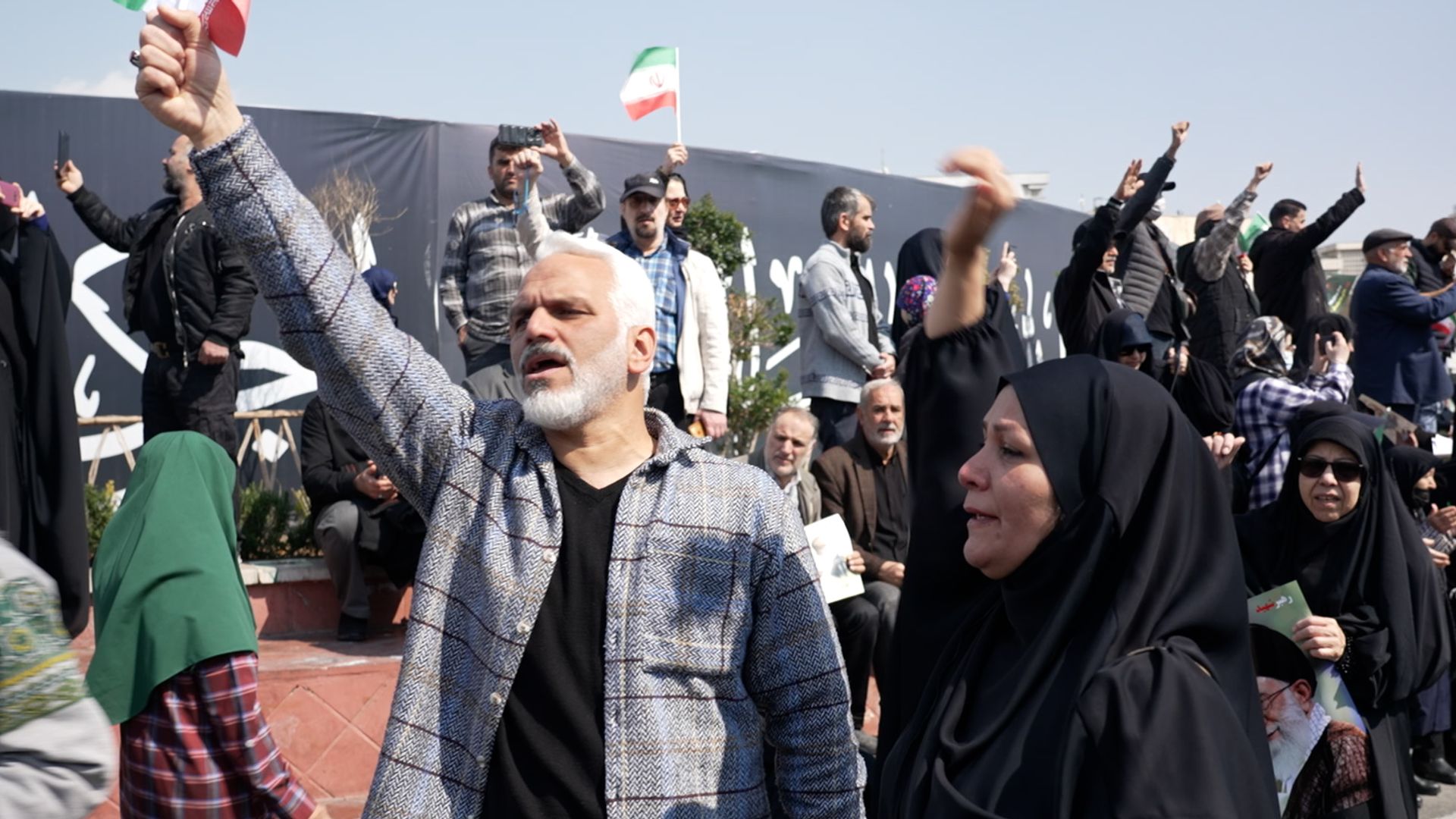
The air in southern Iran does not just sit; it clings. It carries the salt of the Persian Gulf and the metallic tang of diesel, a combination that stays in the back of your throat long after you leave the docks. But on this morning, the usual mechanical roar of the shipyards was replaced by something far denser. Thousands of feet shuffled over the pavement in a rhythmic, muffled drumbeat.
When a nation buries its high-ranking protectors, the ceremony is never just about the men in the caskets. It is a choreographed display of resilience, a physical manifestation of a geopolitical stance. In the port city of Bandar Abbas, the funeral for a senior security official and the crew of a naval vessel was not merely a local mourning period. It was a loud, crowded statement made in a region where silence is often interpreted as weakness.
Imagine the perspective of a young sailor standing on the periphery of the crowd. To him, the "security chief" isn't a headline or a title on a military ledger. He is the man who signed the orders, the one who navigated the impossible bureaucracy of maritime defense. The navy crew members aren't statistics in a regional power struggle. They are the faces from the mess hall, the hands that coiled the same ropes, the voices that joked about the heat when the sun hit its zenith.
The sheer scale of the gathering tells a story that data points cannot capture. When thousands of people descend upon the streets, the individual disappears into a sea of black cloth and raised banners. The heat radiates off the asphalt, making the horizon shimmer, but no one moves toward the shade. There is a specific kind of endurance required for this. It is the endurance of a population that has grown used to the weight of the "security state" as both a shield and a heavy garment.
The naval crew lost in the line of duty represents a specific kind of vulnerability that Iran rarely admits to. The Gulf is a narrow, crowded corridor. It is a place where a single mechanical failure or a split-second miscalculation can lead to a watery grave. While official reports often lean on the language of "martyrdom" and "national duty," the reality on the ground is much more visceral. It is the sound of a mother wailing over a draped flag. It is the sight of young men in crisp uniforms trying to keep their composure while their shoulders shake.
Why does it matter that the crowds were so large?
In the West, we often view these events through the lens of state-mandated attendance. We see the cameras and assume every person there is a prop in a play. But that dismissal ignores the genuine, complex grief of a community tied to the sea. In Bandar Abbas, the navy is the lifeblood. When a ship goes down or a commander falls, the ripples hit every household. The "invisible stakes" here aren't just about regional hegemony or the control of shipping lanes. They are about the social contract between a government that asks for total sacrifice and a people who show up to claim their dead.
Consider the logistics of such a loss. The security chief was a bridge between the central command in Tehran and the practical, gritty reality of the southern coast. Replacing that level of institutional memory isn't as simple as promoted a subordinate. It leaves a vacuum. The crew, too, represented years of specialized training in a navy that must constantly innovate to bypass international restrictions. Each life lost is a specialized tool broken, a library of lived experience burned to the ground.
The procession moved like a slow, dark river toward the burial site. The scent of rosewater fought against the smell of the sea. There is a haunting beauty in the way Iranian funerals utilize color—the deep greens of the flags, the stark white of the shrouds, the black of the mourning dress. It is a visual language designed to be seen from satellites, but its impact is felt most sharply by the person standing close enough to see the dust on the boots of the pallbearers.
As the sun began to dip, casting long, distorted shadows across the port, the speeches grew more fervent. They spoke of "unwavering resolve" and "the path of the fallen." Yet, away from the microphones, in the quiet corners of the city, the families were left with the remains of a life. A pair of boots. A watch that stopped. A letter that arrived too late.
The world watches the Persian Gulf for oil prices and military maneuvers. It tracks the movement of destroyers and the rhetoric of generals. But the true temperature of the region is found in the dirt of the cemeteries. It is found in the collective breath of thousands of people standing in the dust, waiting for the signal to let go.
The coffins were lowered. The earth was moved. The officials climbed back into their armored cars, and the sailors returned to their barracks. But the salt stayed in the air, and the silence that followed the crowd was heavier than the noise that preceded it. In the end, the sea remains indifferent to the titles of the men who sail it, but the land remembers every one of them.
The last of the mourners lingered until the stars began to poke through the haze, their silhouettes small against the backdrop of the massive gray hulls of the ships docked nearby. They didn't talk about policy. They didn't talk about the enemy. They simply stood there, watching the tide come in, knowing that tomorrow, the water would look exactly the same as it did the day the world changed for them.
Would you like me to analyze the geopolitical implications of recent maritime security shifts in the Persian Gulf?