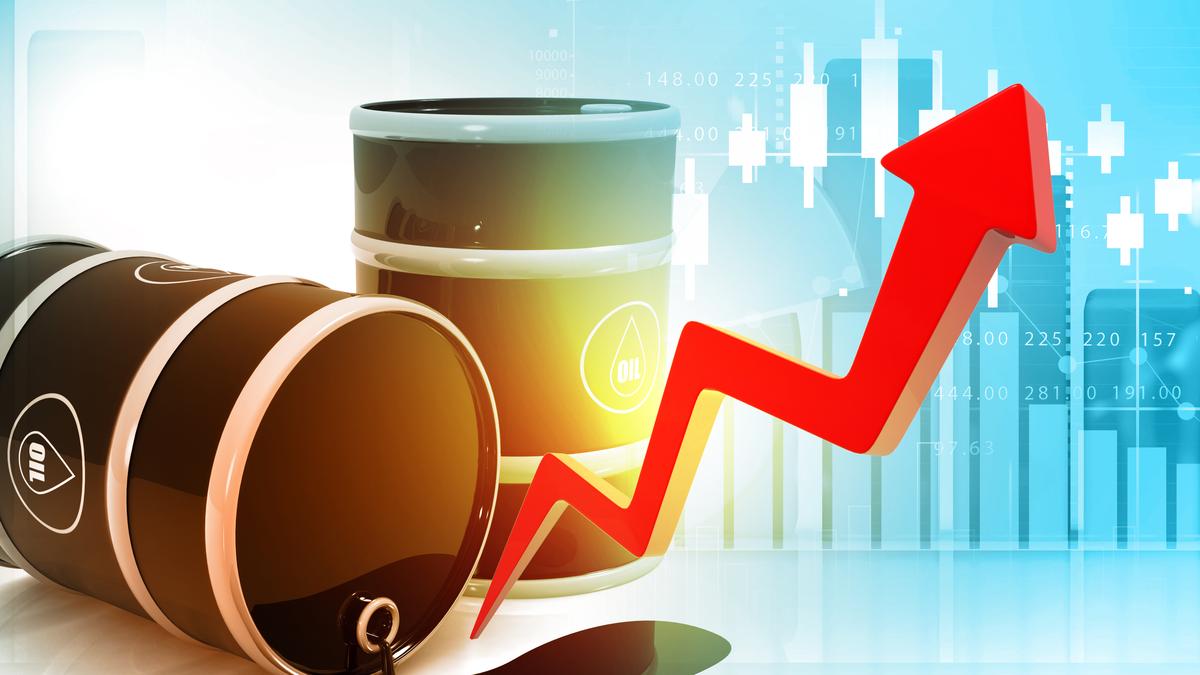
The alarm clock doesn't care about geopolitical posturing. At 6:00 AM in a suburb outside Des Moines, or perhaps a flat in London, a person reaches for their phone. They see the notification: Brent crude has climbed again. It is a number on a screen, abstract and cold. But by the time that same person pulls into a gas station three days later, the abstraction has turned into a very real, very sharp bite out of a weekly budget.
We often treat the economy like a weather pattern—something that happens to us, unpredictable and distant. We speak in the jargon of "surges" and "volatility" as if these are forces of nature rather than the collective heartbeat of human fear and ambition. Right now, that heartbeat is erratic. Building on this idea, you can also read: The Childcare Safety Myth and the Bureaucratic Death Spiral.
The Geography of Anxiety
Thousands of miles away, the horizon is thick with the smoke of a conflict that refuses to stay local. West Asia is not just a spot on a map; it is the world’s heavy-duty pressure valve. When tension rises there, the valve tightens. Traders in glass towers in Manhattan or Singapore don't wait for the oil to stop flowing before they react. They buy on the whisper of risk.
This is the psychological tax of war. Even before a single tanker is delayed, the possibility of a closed strait or a struck refinery sends a shiver through the global supply chain. It is a domino effect where the first tile is pushed by a missile, and the last tile hits the cost of a gallon of milk in a supermarket. Experts at Harvard Business Review have also weighed in on this situation.
Consider a hypothetical independent trucker named Elias. Elias doesn't follow the intricacies of foreign policy committees. He follows the price of diesel. When the barrel price jumps due to escalations in the Middle East, Elias’s margins vanish. To keep his truck on the road, he has to charge more to the companies whose goods he hauls. The logistics firm passes that cost to the retailer. The retailer passes it to you. This is how a desert conflict enters your kitchen.
The Jobs Report Paradox
While the world watches the flickers of fire in the East, a different kind of fire is burning in the halls of the U.S. Bureau of Labor Statistics. The latest jobs data just landed, and it was a "beat." More jobs were added than anyone expected. In a vacuum, this is a victory. It means people are working. It means the engine is humming.
But the market reacted with a flinch.
Why does good news feel like a punch to the gut for investors? Because of the shadow of the Federal Reserve. A "hot" jobs market suggests that the economy might be running too fast, threatening to pull inflation back out of its cage. If everyone is employed and spending, prices stay high. If prices stay high, the central bank keeps interest rates "higher for longer."
The dream of "easy money"—the low-interest rates that make buying a home or expanding a small business affordable—is slipping away. We are caught in a strange tug-of-war. On one side, the resilience of the worker keeps the floor from falling out. On the other, the cost of borrowing acts as a ceiling that keeps getting lower.
The Silent Squeeze at the Kitchen Table
Wealth isn't just about what you earn; it’s about what your earnings can actually do. This is the "real" economy. While the S&P 500 might dip or dive based on a Friday morning report, the human experience is measured in trade-offs.
When energy prices rise and interest rates refuse to budge, the middle class begins a series of quiet subtractions. Maybe the summer vacation becomes a weekend camping trip. Maybe the new car remains on the lot for another year. These aren't catastrophic events individually, but collectively, they represent a cooling of human aspiration.
We are living through a period of profound uncertainty where the macro and the micro are colliding with bruising force. The "West Asia premium" on oil is essentially a tax on global stability. Meanwhile, the U.S. labor market's strength is being treated as a problem to be solved rather than a milestone to be celebrated. It is a dizzying, contradictory moment.
The Fragility of the Flow
Everything we touch is a product of movement. The laptop you use, the fruit you eat, the clothes you wear—they all exist because of a global choreography of ships, planes, and trucks. This system relies on two things: affordable fuel and predictable credit.
Currently, both are under siege.
The conflict in West Asia threatens the fuel. The stubbornness of inflation—fueled by that surprisingly robust jobs market—threatens the credit. If you feel a sense of unease when you look at your bank account, you aren't imagining things. You are sensing the friction of a world trying to recalibrate after decades of relative calm.
There is a human cost to this friction that spreadsheets can't capture. It is the stress of the small business owner who sees their electricity bill double. It is the anxiety of the young couple trying to lock in a mortgage while the "experts" debate whether the Fed will pivot or hold. These are the stakes. Not points on an index, but the ability of a family to plan for a future that feels stable.
The reality of 2026 is that the "far away" no longer exists. A drone strike in a distant harbor is a line item on your monthly expenses. A hiring spree in a tech hub is a reason your credit card interest rate stayed high. We are all participants in this narrative, whether we want to be or not.
The machines of global trade are still turning, but the oil that greases them is getting more expensive, and the hands that turn the gears are growing weary of the constant shifts. We are waiting for a signal—a moment of de-escalation or a clear path toward lower costs. Until then, we watch the screens, check the pumps, and try to find our footing on ground that won't stop moving.
The next time you see a headline about crude oil or employment percentages, look past the digits. See the trucker. See the homeowner. See the invisible thread that connects a flash of light in a distant sky to the quiet choices you make at the dinner table tonight.
We are not just observers of the economy. We are the fuel.