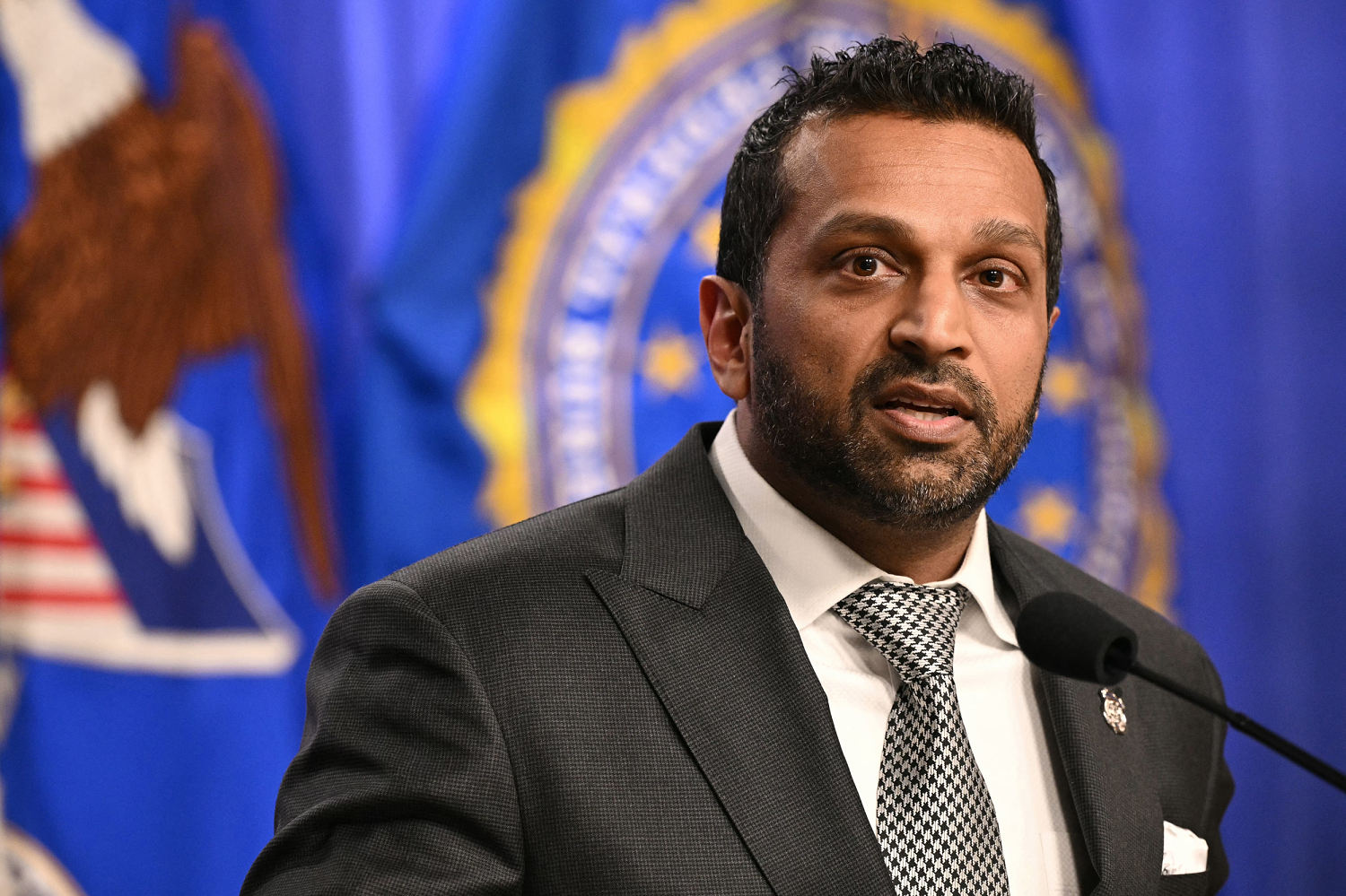
Kash Patel just hit another legal brick wall. A federal judge in Texas recently tossed his defamation lawsuit against Frank Figliuzzi, a former FBI assistant director and frequent MSNBC contributor. This isn't just another boring court ruling; it's a loud reminder that if you're a high-profile public official, you can't just sue everyone who makes a joke at your expense on cable news.
The case centered on a segment of Morning Joe. During the broadcast, Figliuzzi suggested that Patel—who is currently serving as the FBI Director in 2026—had been "visible at nightclubs far more than he has been on the seventh floor of the Hoover building." Patel didn't find it funny. He claimed the comment was a malicious lie intended to paint him as a slacker who prefers bottle service to national security.
Judge George C. Hanks Jr. didn't buy it. He ruled that Figliuzzi’s jab was "rhetorical hyperbole." Basically, the court decided that no reasonable person watching the show would think Patel literally spends 23 hours a day at the club and zero minutes at his desk. It’s an "extravagant exaggeration" used for effect, and in the eyes of the law, that makes it protected speech.
The high bar of actual malice
If you want to understand why these cases almost always fail, you have to look at the standard of actual malice. This isn't about someone being "mean" or having a "malicious" vibe. Since the landmark 1964 Supreme Court case New York Times Co. v. Sullivan, public figures like Patel have to prove that a speaker knew what they were saying was false or acted with "reckless disregard" for the truth.
In this Texas ruling, the judge leaned heavily on the idea that political commentary is supposed to be provocative. When Figliuzzi made his crack about nightclubs, he was responding to a question about Patel’s "surprisingly backseat role" during his first few months in office. The court found that because the statement was made in a context of opinion and hyperbole, it didn't even reach the level where "actual malice" mattered. It wasn't a factual claim to begin with.
Patel has a history of using the legal system to swing at his critics. He’s currently in the middle of a massive $250 million suit against The Atlantic over an article alleging "bouts of excessive drinking" and "unexplained absences." While that case is more complex because it involves specific factual allegations from anonymous sources, the Figliuzzi dismissal shows that judges are increasingly tired of defamation suits being used as a PR tool to silence critics.
Why this matters for the FBI and the public
This isn't just about two guys bickering over a TV segment. You’re looking at the sitting Director of the FBI suing a private citizen for a comment made on a news program. That carries a lot of weight. If the court had let this go forward, it could have set a precedent where any government official could sue a journalist or pundit for using a metaphor or making a sarcastic remark.
- Free speech protection: The ruling reinforces that "extravagant exaggeration" is a vital part of American political discourse.
- Accountability: It signals to public officials that they can't use the courts to scrub their reputations of every unflattering comparison.
- Legal Costs: These suits are expensive. While Patel might have the resources to keep filing them, the defendants have to spend massive amounts on legal fees to prove they have the right to speak.
Honestly, Patel’s legal strategy seems to mirror the "playbook" used by his boss. We saw a similar move last week when a judge in Florida threw out a $10 billion suit by Donald Trump against the Wall Street Journal. In both cases, the courts found that the plaintiffs failed to show the "actual malice" required to win.
The nightclub comment vs reality
The irony here is that Patel’s lawsuit actually brought more attention to the nightclub comment. It’s a classic example of the Streisand Effect. By trying to suppress the idea that he’s a "nightlife guy," he’s made sure that every news outlet in the country repeats the quote.
Figliuzzi’s defense was pretty straightforward. He argued that his words were clearly intended as a critique of Patel's leadership style and visibility, not a literal log of his GPS coordinates. Texas law is particularly protective of this kind of "provocative and amusing" speech. The court cited New Times, Inc. v. Isaacks, a famous Texas case involving a parody that was so ridiculous it couldn't be taken seriously.
If you’re a public official, you’ve gotta have thicker skin. That’s the core message from Judge Hanks. The seventh floor of the J. Edgar Hoover building is a high-pressure environment, but so is the court of public opinion.
What happens next for Kash Patel
Don't expect Patel to back down. His $250 million battle with The Atlantic is the one to watch. Unlike the MSNBC case, The Atlantic story claimed that briefings had to be rescheduled because of Patel's behavior and that his security team struggled to wake him up behind locked doors. These are specific, factual claims.
The Atlantic says they have more than two dozen sources. Patel says they’re "sham sources." This is where the legal battle gets dirty. If that case goes to discovery, we might see internal FBI logs, testimony from agents, and even more embarrassing details than a simple "nightclub" joke.
If you're following these cases, the next step is to keep an eye on the D.C. District Court filings for the Atlantic suit. That's where the real evidence—or lack thereof—will come to light. For now, the takeaway is simple: if someone calls you a party animal on TV, it’s probably not worth a lawsuit. You’ll likely lose, and you’ll definitely make the joke more famous than it was before you called your lawyers.
Stop expecting the courts to protect your feelings. Start focusing on the job. That’s the only way to actually win in the long run.