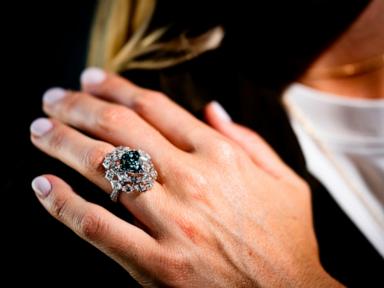
You don't just "buy" a diamond like the Ocean Dream. You fight for it. On Wednesday in Geneva, that's exactly what happened when an anonymous buyer dropped over $17.3 million (13.5 million Swiss francs) at Christie’s to secure a 5.50-carat shield-cut stone that looks like it was plucked straight from a Caribbean reef.
The price tag is staggering, but it’s the back-and-forth that tells the real story. Bidding dragged on for 20 minutes. In the high-stakes world of Christie’s "Magnificent Jewels" auctions, 20 minutes is an eternity. Most lots fly off the block in two or three. This wasn't a quick transaction; it was a psychological battle for a piece of geological history that shouldn't even exist. Meanwhile, you can read similar stories here: Why rent-vesting still makes sense despite Labor tax changes.
The weird science behind the blue green glow
Nature doesn't usually make diamonds this color. Most colored diamonds get their hue from chemical impurities—nitrogen makes them yellow, boron turns them blue. But the Ocean Dream is different. Its teal-like "Fancy Vivid Blue-Green" shade comes from millions of years of exposure to natural radiation in the earth's crust.
Usually, when a lab sees a green diamond, they assume someone tampered with it in a basement. It's too easy to fake. But the Gemological Institute of America (GIA) spent years studying this stone to prove its color was 100% natural. It’s a freak of nature. While blue diamonds and green diamonds are rare enough on their own, finding a hybrid with this level of saturation is practically unheard of. To understand the complete picture, we recommend the recent analysis by ELLE.
The stone originally came from a rough 11.70-carat rock found in Central Africa back in the 90s. The cutting process was a massive gamble. One wrong move or a bit of excess heat during the grinding process can actually "cook" the radiation out of a stone like this, potentially ruining that signature color forever.
Tracking the 100 percent price jump
If you think $17 million is a lot, look at the math from the last time this stone hit the market. In 2014, the Ocean Dream sold for about $8.5 million. It basically doubled its value in 12 years.
That’s not just inflation. We’re seeing a massive shift in how the ultra-wealthy hedge their bets. While the stock market fluctuates and crypto does its chaotic dance, "hard assets" like fancy colored diamonds have become the ultimate vault play. There’s a finite supply of these things. You can't mine more "Ocean Dreams" because the conditions that created them aren't happening anymore.
Compare this to the 6-carat blue diamond that sat unsold at Sotheby’s just a day earlier. That stone had a $12 million high estimate and nobody bit. It shows that even at this level, buyers aren't just throwing money at anything shiny. They want the unicorns. They want the stuff that the Smithsonian explicitly calls one of the rarest diamonds in the world.
Why size doesn't always matter in Geneva
At 5.50 carats, the Ocean Dream is tiny compared to famous clear diamonds that weigh hundreds of carats. But in the world of colored stones, it’s a heavyweight champion.
Most natural green diamonds found are under one carat. When they do get bigger, the color is usually pale or patchy. To have a 5-carat stone with "Fancy Vivid" saturation—the highest possible grade—is like finding a needle in a haystack, and then finding out the needle is made of solid platinum.
- The Cut: It's a triangular "shield" cut, which is notoriously difficult to pull off without losing too much "face-up" size.
- The Rarity: It was one of only eight stones featured in the Smithsonian's "Splendor of Diamonds" exhibit in 2003.
- The Setting: It's currently mounted in a ring surrounded by smaller white diamonds, but let's be real—the buyer is paying for the main attraction.
What this means for the jewelry market
This sale isn't just a win for Christie’s; it’s a signal to the rest of the market that the demand for "fancy" colors is reaching a fever pitch. We’re seeing more private collectors from Asia and the Middle East entering these Geneva auctions than ever before. In this specific sale, bidders from 40 different countries were fighting over the catalog.
If you're looking at this and wondering if you should start hunting for colored diamonds, don't go buying "chocolate" diamonds at the mall. The investment value is strictly in the GIA-certified "Fancy" grades. Specifically, look for stones with no "secondary" hues that muddy the color—unless that secondary hue is something equally rare, like the blue-green combo seen here.
If you’re serious about entering this space, your first move should be to track the GIA’s auction results for "Fancy Intense" and "Fancy Vivid" stones over the last five years. The data shows a clear upward trend for anything with a natural radiation origin. It's a niche market, but as the Ocean Dream just proved, it's a market that doesn't mind paying a $9 million premium for a little bit of mystery.