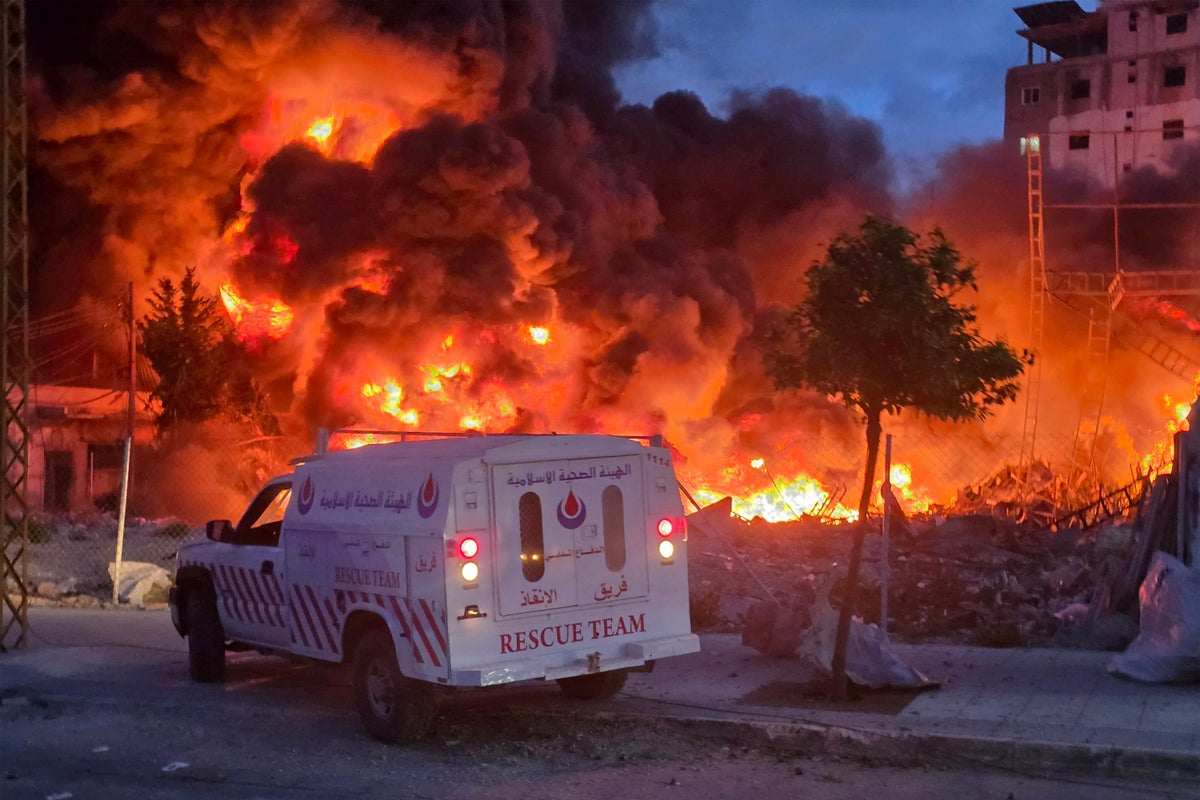
The sixth consecutive day of Israeli kinetic operations against Tehran has shifted from a series of tactical strikes into a sustained campaign of strategic attrition. While global attention remains fixed on the skyline of the Iranian capital, a more immediate humanitarian and logistical disaster is unfolding 700 miles south in Muscat. The failure of the United Kingdom’s first scheduled evacuation flight to depart from Oman reveals a catastrophic miscalculation in Western contingency planning. It is not just a technical delay. It is a symptom of a regional infrastructure that was never designed to handle the sudden, violent intersection of a failing diplomatic corridor and a hot war.
The primary reason for the grounding of the flight is a cascading failure of regional air traffic control and the refusal of private insurers to cover civilian hulls entering what is now a "triple-red" zone. While official government lines might point to "logistical friction," the reality is that the airspace over the Gulf of Oman has become a graveyard for commercial schedules. As Israel continues to hammer critical infrastructure in Tehran, the resulting electronic warfare and GPS spoofing have bled southward, making civilian navigation through the Strait of Hormuz a gamble that most commercial pilots—and their employers—are no longer willing to take.
The Infrastructure of a Failed Exit
The situation in Oman was supposed to be the "clean" solution for British nationals and designated personnel fleeing the expanding radius of the Iran-US conflict. Instead, the airport in Muscat has become a bottleneck. The failure of that first flight was caused by a specific refusal of the Omani authorities to grant departure clearance after the Iranian Revolutionary Guard Corps (IRGC) activated mobile surface-to-air batteries along the southern coastline. This isn't a mere delay. It is a blockade in all but name.
When a government-chartered aircraft fails to move, it sends a signal of weakness to the entire region. The UK Foreign Office had gambled on the idea that Oman’s traditional neutrality would provide a "safe harbor" effect. That bet has failed. The IRGC understands that by creating uncertainty in Omani airspace, they can trap Western assets and citizens, using them as de facto shields against further escalation or as bargaining chips in the inevitable back-channel negotiations.
Why the Strikes on Tehran Won’t Stop
Israel’s sixth day of strikes has targeted a very specific subset of targets: the hardened communication nodes used by the IRGC to coordinate with its proxies in Lebanon and Yemen. Unlike the initial waves of the conflict, which focused on visible missile silos, these strikes are surgical and focused on the "brain" of the Iranian military apparatus.
By hitting these nodes, Israel is attempting to deafen the Iranian command structure before a potential US entry into the conflict. The US has maintained a stance of "defensive readiness," but the presence of carrier strike groups in the North Arabian Sea suggests that the window for a purely localized conflict has closed. The US is already providing the real-time intelligence and mid-air refueling that makes these six-day sustained operations possible for the Israeli Air Force.
The Hidden Cost of Tactical Success
We have seen this pattern before in regional conflicts, but never with this level of technological intensity. The Israeli military is using advanced electronic suppression to "blind" Tehran’s radar, but these signals do not stop at national borders. They wash over the entire Persian Gulf.
This leads to a phenomenon known as "electronic smog." Commercial aviation depends on precise, uncorrupted data. When the skies are filled with high-output jamming signals, civilian transponders fail. This is why the flight from Oman didn't take off. It wasn't just a broken engine or a missing manifest. The pilots literally could not guarantee they wouldn't be misidentified as a hostile target by a jumpy air defense operator on either side of the gulf.
The Oman Dilemma for the West
For decades, Oman has been the "Switzerland of the Middle East." It is the place where the US and Iran talk when they aren't speaking. By allowing the evacuation flights to stall, Muscat is signaling that its ability to remain neutral is being crushed by the weight of the conflict.
- Insurance Premiums: War risk insurance for aircraft in the region has spiked by 400% in forty-eight hours.
- Fuel Logistics: Jet fuel supplies in Muscat are being diverted to military use, leaving civilian charters at the back of the line.
- Diplomatic Paralysis: The UK's inability to move its own people suggests a breakdown in the special relationship’s ability to secure regional cooperation.
This is a failure of statecraft. If the UK cannot move a single flight out of a friendly nation like Oman, the prospects for a mass evacuation from more volatile areas are non-existent.
The Reality of the Sixth Day
On the ground in Tehran, the narrative is one of defiance, but the data tells a different story. The strikes have begun to hit the energy grid. This is a classic escalation ladder. First, you hit the military sites. Then, you hit the command and control. Finally, you hit the dual-use infrastructure that keeps the lights on.
Israel is currently on step three. The intent is to make the cost of continuing the war unbearable for the Iranian civilian population, hoping to trigger internal pressure on the regime. However, this strategy historically backfires in the short term, as it often rallies a population around the flag. The US is watching this closely, knowing that every missile that hits a power plant in Tehran moves the US closer to a direct kinetic engagement.
The Misunderstood Role of the US Navy
The American presence in the region is often described as a deterrent. In reality, it is a massive logistical backbone. The US isn't just "watching" the strikes; it is managing the "deconfliction" of the entire region’s airspace. Every time an Israeli jet moves toward Tehran, a complex web of US satellites and Aegis-equipped destroyers ensures that no other regional actor intervenes.
The failure in Oman is an embarrassment for this apparatus. It shows that while the US can control the military "high ground," it has lost its grip on the civilian "low ground." If you can't get a busload of teachers and diplomats out of Muscat, you don't have control of the situation.
The Coming Week of Attrition
As we move into the second week of this campaign, the focus will likely shift from Tehran to the coastal assets of the IRGC. This will put even more pressure on the evacuation corridors in Oman and the UAE. The "failed flight" in Muscat will not be an isolated incident; it will be the new baseline.
Governments are currently advising their citizens to "shelter in place," which is diplomatic shorthand for "we cannot get you out." This is a terrifying prospect for the thousands of foreign nationals currently caught between Israel’s air campaign and Iran’s internal security crackdown. The window for an orderly exit has not just closed; it has been welded shut by the heat of the strikes.
The focus must now shift to the sea. If the air corridors are dead, the only remaining route is the water. But with the IRGC’s navy specialized in swarm tactics and mine-laying, the Gulf of Oman is no longer a sea—it’s a minefield. The UK and its allies are now facing the reality that their primary evacuation plan was built for a world that ceased to exist six days ago.
Strategic planning requires more than just hope and a charter contract. It requires a hard-nosed assessment of how a kinetic war in the north ripples through the logistics of the south. Right now, that assessment is showing a total system failure. Use the next twenty-four hours to secure ground-level resources, because the next flight out of Muscat isn't coming anytime soon.
Find a secure location away from telecommunications hubs and wait for the maritime corridors to open.