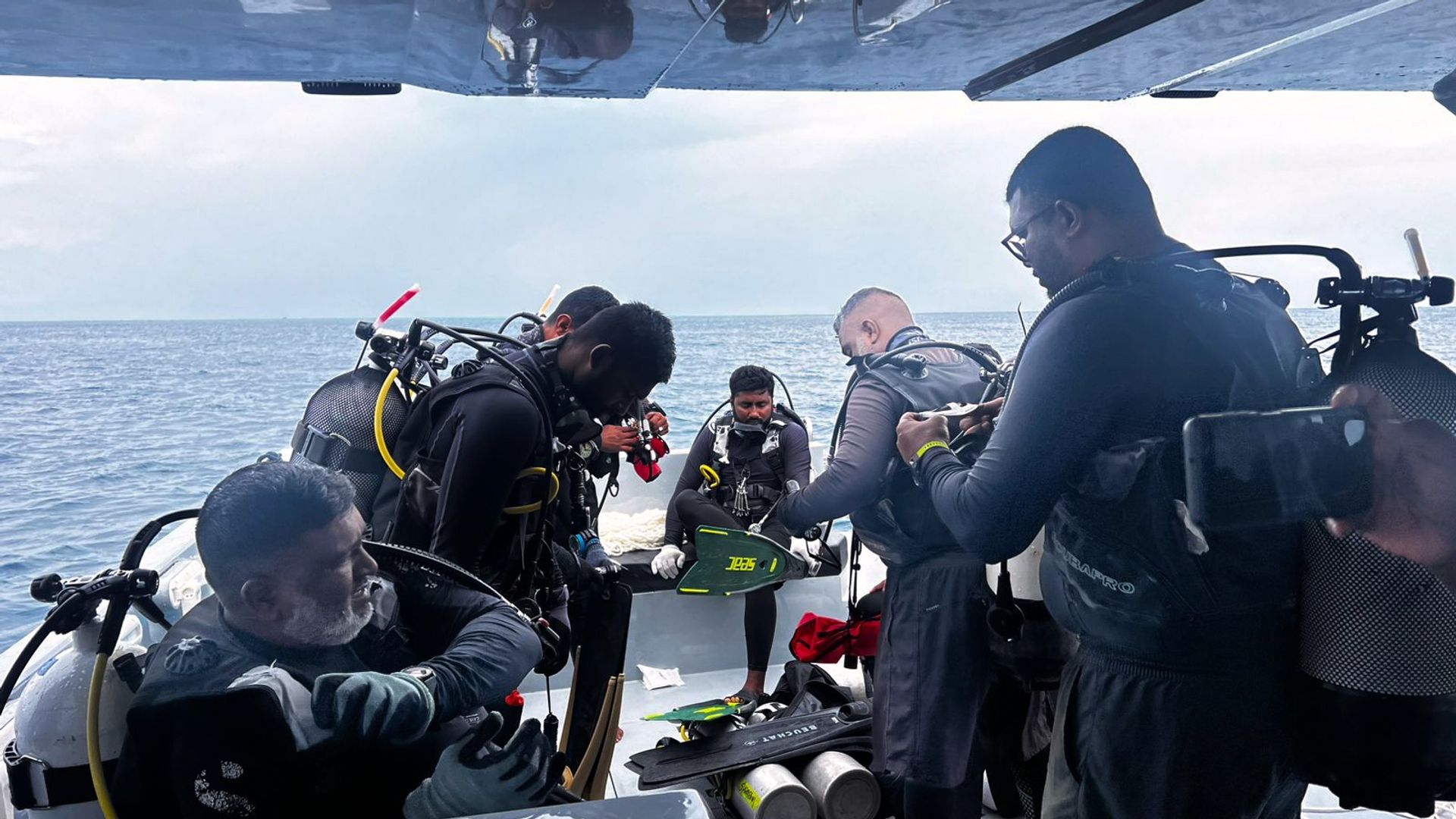
The arrival of specialized Finnish diving teams in the Maldives marks a transition from localized emergency response to a technical recovery operation. When a maritime incident involving multiple casualties occurs in deep-water environments, the success of the mission is dictated by three critical variables: bathymetric complexity, physiological depth limits, and the degradation of evidence over time. The search for the four missing Italian citizens has moved beyond the "golden window" of survival, shifting the strategic objective toward forensic recovery and environmental analysis.
The Triad of Deep Water Recovery Constraints
The Maldives archipelago presents a unique set of geographic challenges that complicate standard search and rescue (SAR) protocols. To understand why Finnish expertise—often honed in the low-visibility, cold-water environments of the Baltic—is applicable here, one must examine the specific mechanics of the Indian Ocean's underwater topography.
1. Vertical Complexity and the Drop-off Effect
The Maldives is composed of atolls resting on a vast submarine mountain range. The transition from the shallow lagoons (inner atoll) to the open ocean (outer atoll) is not a gradual slope but a vertical shear known as the "drop-off."
- Inner Atoll Depth: 20 to 50 meters.
- Outer Atoll Depth: 2,000+ meters.
If a vessel or divers are caught in a current that pulls them over the reef edge, they exit the range of recreational diving (40 meters) and technical diving (100 meters) within seconds. Recovery at these depths requires Remotely Operated Vehicles (ROVs) or saturation diving teams capable of managing extreme partial pressures of oxygen and nitrogen.
2. Kinetic Hydrology
The Maldives is subject to the Monsoon Current system. These currents are not static; they reverse direction seasonally and fluctuate in intensity based on tidal cycles. In the context of a missing persons search, the "Drift Radius" becomes the primary mathematical bottleneck.
The formula for the search area expansion follows a quadratic progression: as time ($t$) increases, the potential area ($A$) where a body or debris might be located expands relative to the velocity of the current ($v$) and the variance of wind-driven surface currents.
$$A = \pi (v \cdot t)^2$$
Without an exact "Point Last Seen" (PLS), the search grid quickly becomes too large for human divers to cover. The Finnish teams provide the technical capacity to execute high-probability grid searches using side-scan sonar, which maps the seafloor more efficiently than visual confirmation.
3. Physiological and Equipment Thresholds
Standard SCUBA equipment is restricted by the physics of gas absorption. At depth, nitrogen becomes narcotic, and oxygen can become toxic. Finnish technical divers typically utilize closed-circuit rebreathers (CCRs) and trimix (a blend of helium, nitrogen, and oxygen). Helium is used to replace a portion of the nitrogen to reduce narcosis, while lower oxygen percentages prevent central nervous system toxicity at depths exceeding 60 meters.
Forensic Recovery and the Biological Timeline
The decision to fly in international specialists suggests that local authorities have reached the limit of their organic capability. In maritime disappearances, the biological state of the missing individuals dictates the recovery methodology.
The Buoyancy Cycle
In tropical waters, the decomposition process is accelerated by high ambient temperatures. This creates a predictable but narrow window for recovery:
- Initial Sinking: Upon drowning, the body loses buoyancy as air in the lungs is replaced by water.
- The Benthic Phase: The body remains on the seafloor. In the Maldives, this could mean the body is trapped in coral structures or has fallen into the deep abyss beyond the drop-off.
- Refloatation: Gas buildup from decomposition may cause a body to rise. However, in deep water (greater than 100 meters), the high hydrostatic pressure can compress these gases, preventing the body from ever reaching the surface.
The Finnish team’s role is likely centered on scanning the Benthic Zone—the seafloor—before the biological window closes or the remains are dispersed by scavengers and currents.
Technological Intervention: Sonar and ROV Integration
The shift from manual diving to technology-augmented search is a move toward risk mitigation. Diving to 100 meters in a high-current environment like the Maldives is inherently dangerous. The operational protocol for the Finnish team likely involves a tiered sensor approach.
Tier 1: Side-Scan Sonar (SSS)
A sonar "tow-fish" is dragged behind a vessel, emitting fan-shaped pulses. This creates a high-resolution "photograph" of the seafloor based on acoustic shadows. The objective is to identify "anomalies" that do not match the surrounding coral or sand patterns.
Tier 2: Multi-Beam Echo Sounder (MBES)
While SSS provides high detail, MBES provides precise 3D bathymetry. This allows the team to understand the exact shape of the reef and identify crevices where a body might be wedged by the current.
Tier 3: Remotely Operated Vehicles (ROVs)
Once an anomaly is identified via sonar, an ROV is deployed. These tethered robots can stay submerged indefinitely, unlike human divers who are limited by decompression obligations. An ROV equipped with a manipulator arm can perform the recovery without risking further loss of life.
The Geopolitical and Economic Friction of International SAR
The presence of Finnish divers in a search for Italian citizens in Maldivian waters highlights a complex intersection of international maritime law and the "Duty of Care" in the tourism industry.
The Maldives economy is approximately 28% dependent on tourism. A high-profile disappearance of European tourists creates a significant reputational risk. By allowing or facilitating international expert intervention, the Maldivian government attempts to demonstrate a "best-efforts" approach. However, this creates a logistical bottleneck:
- Jurisdiction: The Maldivian Coast Guard retains command, but technical execution is outsourced.
- Data Sharing: Sonar data collected by foreign entities must be processed and handed over to local police for forensic filing.
- Cost Absorption: High-tech recovery operations can cost tens of thousands of dollars per day. The funding usually stems from a combination of travel insurance, the home country's consular budget, and the local government’s emergency fund.
The Strategy of the Deep-Water Grid
The current mission profile must focus on the "Statistical Search Area." Because the search has entered its second week, the probability of finding the missing Italians within the inner atoll is statistically low. The logic dictates that if they were in shallow water, they would have been spotted by the numerous dive boats and local fishing vessels that frequent these areas.
The Finnish team’s arrival suggests the search is moving to the "High-Risk, High-Depth" zones.
The operational priority is now the identification of the Submerged Drift Path. This involves dropping GPS-tracked drifter buoys at the Point Last Seen to map exactly how the water was moving at the time of the disappearance. By overlaying this drift data with sonar maps of the drop-off, the team can narrow the search to specific "catchment zones" on the seafloor where debris naturally accumulates.
The search for the four Italians is no longer a rescue mission; it is a high-stakes forensic engineering problem. The success of the Finnish team depends less on their ability to swim and more on their ability to interpret acoustic data and manage the physics of the deep ocean.
Final strategic deployment requires the immediate synchronization of the local Coast Guard’s surface drift models with the Finnish team’s sub-surface sonar arrays. The focus must shift entirely to the leeward side of the nearest channel exits, as these serve as the primary exit points for any objects caught in the outgoing tidal flow. This is the only remaining high-probability zone for recovery before the deep-ocean currents render the remains unrecoverable.