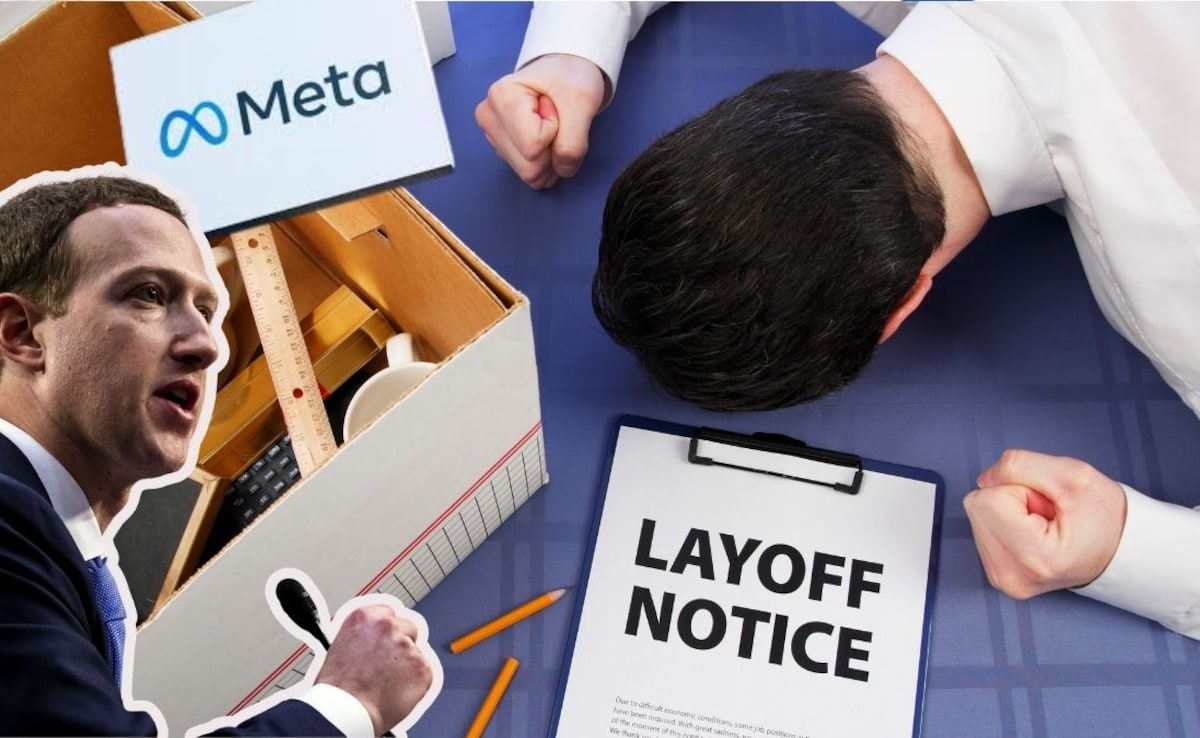
The light from a laptop screen at 2:00 AM isn't white. It is a pale, sickly blue that washes the color out of a person’s face, making them look like a ghost before they’ve even left the building. For thousands of employees at Meta, that glow has become the color of an impending goodbye.
There is a specific kind of silence that falls over a digital workspace when the rumors start. It isn’t the absence of noise; it’s the absence of breath. You see it in the "typing..." bubbles that appear and vanish in private Slack channels. You feel it in the way people stop joking about the bad coffee and start looking at their internal calendars, wondering if that 15-minute sync on Thursday is a project update or a professional execution. In related news, read about: The Silent Attrition of the Quantum Front.
Meta is preparing to let go of roughly 10% of its workforce. That is the cold, hard fact. But 10% is an abstraction. It is a rounding error on a balance sheet. In reality, 10% is a mid-level engineer named Sarah who just signed a mortgage in Menlo Park. It is a recruiter named Marcus who spent three years pitching "the future of connection" to strangers, only to find his own connection to the company severed by an automated script.
The Machine Needs More Fuel
The logic driving this decision is as old as the steam engine, yet as modern as a neural network. To build the future, you have to burn the present. Mark Zuckerberg has made it clear: Meta is no longer just a social media company. It is an AI powerhouse in the making. But brilliance is expensive. CNET has also covered this fascinating issue in great detail.
The sheer cost of staying relevant in the artificial intelligence race is staggering. We are talking about billions of dollars funneled into H100 GPUs, massive server farms that hum with the heat of a thousand suns, and the rarest commodity of all—the elite researchers who command seven-figure salaries. Money is finite, even for a titan. To fund the birth of a more intelligent machine, the company is choosing to prune the human garden.
Consider the trade-off. For every thousand desks emptied, a new cluster of processors is brought online. In the eyes of Wall Street, this is "operational efficiency." To the person packing a cardboard box, it feels like being replaced by a ghost. We are witnessing a fundamental shift in how value is calculated in Silicon Valley. It used to be about "heads"—how many smart people you could hoard under one roof. Now, it’s about "compute"—how much raw processing power you can exert over the world’s data.
The Myth of the Lean Year
Last year was dubbed the "Year of Efficiency." We were told the cuts were a one-time correction, a sobering wake-up call after the drunken hiring spree of the pandemic. We believed the house was finally in order.
But efficiency isn't a destination; it's a hunger.
Once a company proves it can do more with less, the stakeholders demand they do even more with even less than that. The 10% figure being whispered about today isn't a sign of failure. Ironically, it’s a sign of a new kind of success. Meta’s stock has clawed its way back to record highs, and the reward for that success is a mandate to go faster. To go faster, you have to be lighter.
When you sit across from a colleague in a glass-walled conference room, you aren't just looking at a friend. You are looking at a budget line. If your role doesn't directly contribute to the training of Llama 3 or the integration of generative tools into Instagram, you are standing on a shrinking island. The tide isn't coming in; the island is being sold for parts to build a bridge to the AI horizon.
The Invisible Stakes of the Pivot
What happens to the culture of a place when the floor is constantly vibrating with the threat of the next "restructuring"?
Innovation requires a certain level of psychological safety. You have to feel secure enough to fail, to pitch a "stupid" idea that might turn into a breakthrough. But when 10% of the seats are earmarked for removal, the "stupid" ideas stay in people’s heads. Everyone plays it safe. Everyone tries to look busy in the exact way the algorithm likes.
The human cost extends far beyond the severance check. It’s the erosion of trust. It’s the realization that the "mission" of connecting the world is secondary to the mission of perfecting the model. There is a profound irony in a company dedicated to human connection deciding that thousands of those connections are disposable in favor of a synthetic brain.
We often talk about AI as a tool that will "augment" human work. We are told it will take over the drudgery, freeing us to do the creative, high-level thinking we were born for. But in the boardrooms where these layoffs are decided, the narrative is different. There, AI isn't an assistant; it’s a replacement for the overhead. It’s a way to scale without the messy, unpredictable, expensive complications of human beings who need healthcare, maternity leave, and sleep.
A Walk Through the Virtual Graveyard
Hypothetically, let’s look at "Reality Labs." This is the division responsible for the Metaverse—the dream that almost sank the ship two years ago. Thousands of people were hired to build a digital utopia where we would all hang out as legless avatars. Now, many of those same people are being shown the door because the dream has shifted. The Metaverse isn't dead, but it’s being re-skinned with AI.
If you were hired to build a virtual world, but the company now wants that world to be generated on the fly by a prompt, where do you fit? You don't. You become a legacy asset in a company that is allergic to the past.
The transition is brutal because it is so logical. If you can spend $100 million on a group of engineers or $100 million on a server farm that works 24/7 without complaining about the lack of free kombucha, the math makes the choice for you. The CFO doesn't see the tears in the parking lot. They see a chart where the "Revenue per Employee" line is trending sharply upward.
The Loneliness of the Long-Term Bet
There is a vulnerability in Mark Zuckerberg’s position that few people acknowledge. He is betting the entire kingdom on a technology that is still, in many ways, an infant. He is clearing out the ranks to ensure he has the war chest to fight Google, Microsoft, and OpenAI. It is a lonely, high-stakes gamble. If he’s right, Meta becomes the operating system of the next century. If he’s wrong, he’s gutted his greatest asset—his people—for a hallucination.
The employees who remain will be asked to do the work of those who left, fueled by the "opportunity" to work on the frontier of technology. They will attend "All Hands" meetings where the language will be about "focus" and "intensity." They will be told that this is how greatness is forged.
But they will also look at the empty desks next to them. They will remember the names of the people who were there on Monday and gone on Tuesday. They will realize that in the age of the machine, the most valuable thing you can be is indispensable—and the company is working every day to make sure no human is.
The blue light of the laptop stays on. The work continues. The code is written. But the heartbeat of the company has changed. It’s faster, colder, and more rhythmic. It sounds less like a conversation and more like a clock ticking down to zero.
A notification pops up on a screen in a darkened home office. It’s an invite for a mandatory meeting. No agenda. No context. Just a time and a link. In that moment, the multi-billion dollar AI revolution isn't a marvel of human ingenuity. It’s just a cold wind blowing through a house that used to be full.