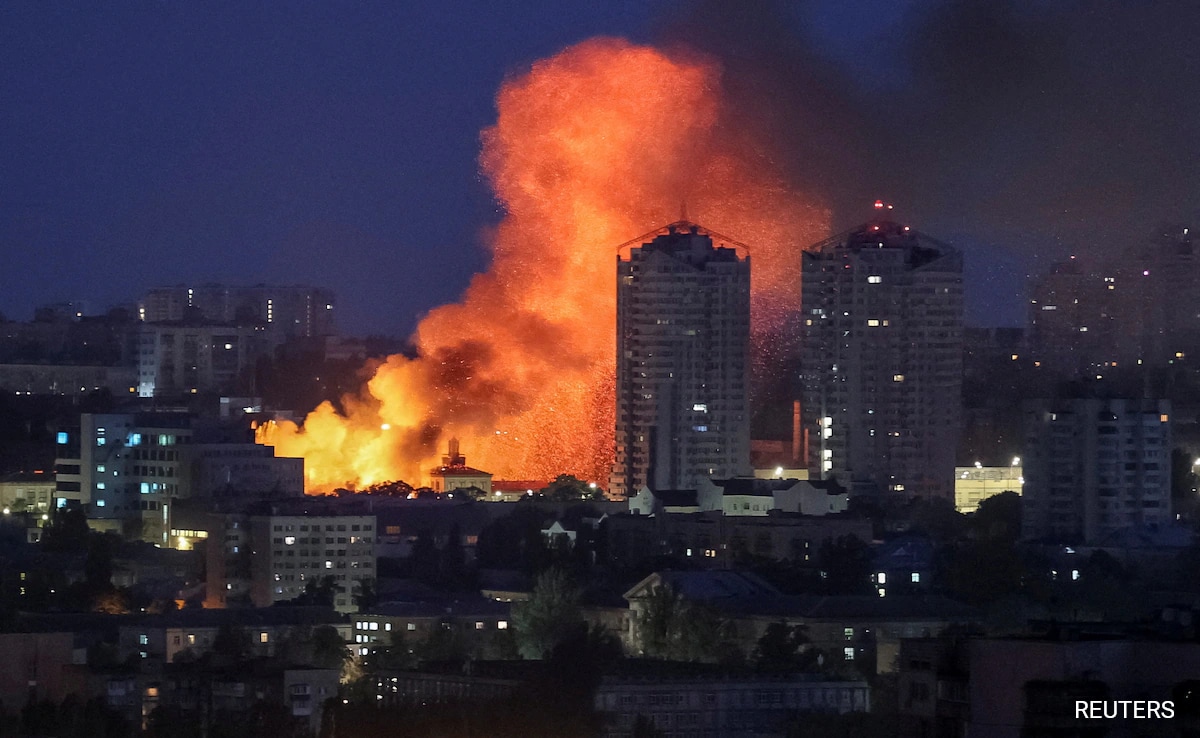
Russia just threw everything at the wall to see what sticks. Overnight, Ukrainian skies filled with the buzzing of over 400 drones, marking the largest single aerial assault of its kind in months. If you’ve been following the conflict, you know that numbers like this aren't just statistics. They represent a deliberate attempt to overwhelm air defenses that are already stretched thin. It’s a numbers game now.
The sheer scale of this 400-drone swarm tells us a few things about where the Kremlin’s head is at. They aren't just aiming for specific power plants or military depots anymore. They're trying to find the "saturation point." That’s the moment when Ukraine has more targets in the air than it has missiles to shoot them down. When that happens, the drones that get through do the real damage. Discover more on a connected topic: this related article.
The Reality of the 400 Drone Blitz
Most people see a headline about 400 drones and think of a coordinated, sci-fi swarm. The reality is messier. These are mostly Shahed-type loitering munitions, often called "mopeds" because of their noisy engines. They’re cheap. They’re slow. And honestly, they’re pretty easy to shoot down individually. But when 400 come at you from different directions, the math changes.
Ukraine’s Air Force reported that they managed to intercept a significant majority of these. That’s a testament to the mobile fire groups and Western-supplied systems like the Gepard or NASAMS. But "most" isn't "all." Even a 90% success rate means 40 drones hit their targets. In a city like Kyiv or Kharkiv, 40 hits can cripple a grid or level a residential block. Additional reporting by The Washington Post explores related perspectives on this issue.
This isn't just about the physical destruction. It’s psychological. Imagine sitting in an apartment building while the air raid sirens wail for six, seven, or eight hours straight. That’s what this attack achieved. It forces a nation to hold its breath while the sky screams.
Why the Drone Strategy Is Shifting Right Now
Russia is pivoting. Earlier in the war, they used expensive cruise missiles for these kinds of shows of force. Those missiles cost millions of dollars each. A Shahed drone costs about $20,000 to $50,000. Do the math. Russia can build or buy thousands of these for the price of a handful of Kalibr missiles.
Cheap Drones vs Expensive Interceptors
This is the biggest headache for Ukraine and its allies. It feels wrong to use a Patriot missile—which costs roughly $4 million—to blow up a drone that costs less than a used Toyota Camry. Russia knows this. They’re essentially trying to bankrupt Ukraine’s arsenal. If Ukraine uses its best missiles on cheap drones, they won't have anything left when the actual ballistic missiles show up.
Ukraine has countered this by using "low-tech" solutions. You’ll see trucks with heavy machine guns mounted on the back, using searchlights and thermal optics to pick these drones out of the night sky. It’s a gritty, manual way to fight a high-tech war. It works, but it’s exhausting for the crews who have to be on high alert every single night.
Probing for Weak Spots
Every one of those 400 drones acted as a sensor. As they fly toward their targets, Russian intelligence watches how Ukraine responds. They see where the radar turns on. They see which cities have the tightest coverage and which ones are vulnerable. This massive attack was a massive data-collection mission. The next attack will be more precise because of what they learned today.
What This Means for Global Security
This isn't just a Ukraine problem. The success of these mass drone strikes is being watched by every military on earth. We're seeing the end of the era where a few high-quality assets can guarantee safety. Quantity has a quality of its own.
Western countries are scrambling to catch up. The U.S. and Europe are looking at their own "Counter-UAS" (Unmanned Aircraft Systems) tech. They realize that if a 400-drone swarm can be launched by a sanctioned nation like Russia, any mid-tier power could do the same. We’re looking at a future where the sky is constantly contested by cheap, disposable tech.
The Economic Impact of Constant Aerial Pressure
Beyond the craters and the smoke, there’s the economic toll. Every time 400 drones head toward Ukraine, the economy stops. Factories shut down. People head to shelters. Repairs to the energy grid cost billions. Russia is betting that they can break the Ukrainian economy before they ever break the Ukrainian military.
Energy remains the primary target. By launching these attacks in waves, Russia ensures that repair crews can never quite get ahead. You fix a transformer today; it gets hit by a drone tomorrow. It's a cycle of frustration designed to make life unlivable for the average person.
Practical Realities on the Ground
If you're wondering how Ukraine keeps going, it’s through a mix of ingenuity and sheer stubbornness. They’ve developed apps where citizens can report the sound or sight of a drone in real-time. This "crowdsourced" air defense helps the military track the flight paths of the swarms. It’s an incredible example of a whole-of-society defense.
But the pressure is mounting. The 400-drone attack is a signal that Russia has scaled up its domestic production. They aren't just relying on shipments from abroad anymore. They've built factories. They've streamlined the process. This means these massive attacks might become the new normal rather than a rare event.
Navigating the Information Fog
In the aftermath of an attack this big, the numbers get blurry. Russia will claim they hit every target. Ukraine will claim they shot down almost everything. The truth usually sits somewhere in the middle, hidden in the satellite imagery and local reports.
Don't just look at the "shot down" percentage. Look at what happens to the lights in the following 48 hours. Look at the water supply. Those are the real metrics of whether a drone attack was "successful" from a tactical standpoint.
The international community needs to stop treating these as isolated incidents. A 400-drone attack is a campaign. It requires a campaign-level response. This means more electronic warfare systems, more automated cannons, and fewer billion-dollar missiles used on fifty-thousand-dollar targets.
The best way to stay informed is to follow independent analysts who look at open-source intelligence (OSINT). Watch for reports from the Institute for the Study of War or verified ground footage. Don't take a single government press release as the gospel truth. Stay skeptical. Stay vigilant. This war is being fought in the air, on the ground, and in the data feeds we consume every day.
Keep an eye on the supply chains. If the West can't find a way to make air defense as cheap as the drones themselves, the math of this war stays in Russia's favor. Support for decentralized, low-cost defense systems is the only logical path forward for Ukraine’s survival in a sky full of drones.