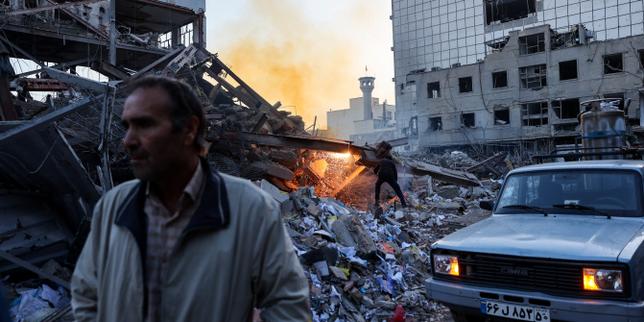
The explosions over Tehran and Karaj did more than rattle windows. They shattered the remaining illusion of domestic immunity that the Islamic Republic has cultivated for decades. While official state media initially scrambled to downplay the precision strikes as minor "noise," the reality on the ground reflects a nation gripping its seat. This is no longer a shadow war fought through proxies in the Levant or Yemen. The front line has moved to the grocery stores, the currency exchanges, and the flickering screens of VPN-reliant smartphones in the heart of the capital.
The immediate fallout is not just physical. It is an accelerated collapse of public trust in the state's ability to provide the most basic of social contracts: safety. When the skies cleared, the questions remained. How did the air defense systems fail to intercept high-altitude threats? Why was the national intranet the only thing that seemed to work perfectly during the chaos? The Iranian public is now forced to reconcile with a regime that looks increasingly fragile even as it projects strength through rhetoric. Recently making news in this space: The Kinetic Deficit Dynamics of Pakistan Afghanistan Cross Border Conflict.
The Economics of Anxiety
War is expensive, but the anticipation of war is often more damaging to a fragile economy. Within hours of the strikes, the rial took another dive against the dollar. This isn't just a number on a chart. For the average family in Mashhad or Isfahan, it means the price of imported medicine and basic proteins like chicken just climbed another 15% out of reach.
Iran operates on a "survival economy." The government has become adept at circumventing sanctions through a complex web of shell companies and maritime "dark fleets," but these mechanisms are designed to keep the state afloat, not the people. The recent strikes have triggered a wave of panic-buying that the Ministry of Trade is struggling to contain. We are seeing a classic bank run in slow motion. People are desperate to convert their liquid assets into anything with tangible value—gold coins, electronics, or even household appliances—before the next round of escalations devalues their savings into worthlessness. Further insights into this topic are covered by The Guardian.
The Infrastructure Gap
The strike targets were reportedly focused on missile production and air defense nodes. However, the psychological damage extends to the civilian power grid. Iran's energy infrastructure is aging. Decades of underinvestment and the inability to source genuine replacement parts for Siemens or ABB equipment have left the grid brittle.
When a military facility loses power, the surrounding civilian districts often go dark too. This creates a feedback loop of fear. In a modern city, a blackout isn't just an inconvenience; it is a loss of communication, refrigeration, and security. The "how" of these strikes—using sophisticated electronic warfare to blind radar—suggests that Iran's digital borders are as porous as its physical ones.
The Digital Iron Curtain
For the Iranian youth, the war is being fought on Telegram and Instagram. Despite the heavy filtering, the "Generation Z" of Tehran is more informed about the strikes than the aging clerics in the Assembly of Experts. They use sophisticated multi-layered VPNs to bypass the Great Firewall of Iran, watching live feeds of their own neighborhoods burning via satellite news channels based in London or Washington.
The government’s response has been a predictable tightening of the digital noose. We are seeing a massive surge in "state-sponsored" misinformation. The goal isn't necessarily to make people believe the government's version of events, but to make the truth so difficult to find that the public simply gives up and sinks into apathy.
Surveillance and the New Social Contract
The Revolutionary Guard (IRGC) has shifted its focus from external defense to internal "stability." This means more checkpoints, more facial recognition cameras at major intersections, and an aggressive crackdown on anyone filming the aftermath of the strikes. The message is clear: the state may not be able to stop foreign missiles, but it can certainly stop you.
This creates a paradox. The more the regime invests in internal security to prevent an uprising triggered by the strikes, the more it drains the treasury, further fueling the economic grievances that lead to unrest in the first place. It is a terminal cycle.
The Strategic Miscalculation
There is a prevailing theory among some Western analysts that pressure from outside will inevitably lead to a collapse from within. This is a dangerous oversimplification. History shows that Iranians, regardless of their feelings toward the current government, have a fierce sense of national pride.
When foreign bombs fall on Iranian soil, the immediate reaction is often a "rally around the flag" effect, however temporary. The regime knows this. They are expertly pivoting the narrative from one of "regime survival" to "national survival." They are framing the strikes not as an attack on military assets, but as an attack on the Iranian identity itself.
The Role of the Shadow Government
To understand why the state hasn't collapsed yet, you have to look at the Bonyads. These are massive, tax-exempt charitable trusts controlled by the IRGC and the Supreme Leader's office. They control upwards of 30% of Iran’s GDP.
- Bonyad Mostazafan: Controls everything from hotels to soft drink factories.
- Setad: An enormous conglomerate built on confiscated property.
- Khatam-al Anbiya: The engineering arm of the IRGC that handles almost all major infrastructure projects.
These entities function as a parallel state. When the formal economy fails, these Bonyads step in to provide "subsidies" that keep the most loyal segments of the population fed and housed. This isn't charity; it is a sophisticated mechanism of social control. As long as the IRGC can keep its own rank-and-file and their families insulated from the worst of the economic pain, the likelihood of a military coup remains near zero.
The Hydrogen Risk
The most overlooked factor in the current escalation is the status of the Bushehr nuclear plant and the various enrichment sites like Natanz. While the recent strikes avoided these areas to prevent an environmental disaster or an irreversible escalation, the "red line" has moved.
Iran’s leadership is now facing a binary choice. They can either come back to the negotiating table from a position of extreme weakness, or they can "break out" and finalize a nuclear deterrent. The latter is increasingly seen by the hardliners in the Supreme National Security Council as the only way to ensure they don't end up like Gaddafi or Saddam Hussein.
The Missile Math
The math of the Middle East has changed. The recent exchange proved that "quantity" is no longer a substitute for "quality." Iran fired hundreds of drones and missiles in previous months, most of which were intercepted. In contrast, the return fire was surgical and devastatingly effective.
$$E_k = \frac{1}{2}mv^2$$
In the world of ballistic physics, velocity and precision are the only metrics that matter. Iran’s missile program, while vast, relies on aging liquid-fuel technology for its longest-range assets. These are slow to prep and easy to spot from space. The technical gap between the IRGC’s capabilities and those of its adversaries isn't just wide; it's a canyon.
The Quiet Exodus
While the headlines focus on the fire and brimstone, the real tragedy is the quiet "brain drain" that has turned into a flood. Anyone with a STEM degree, a nursing certification, or a stash of hard currency is looking for the exit.
In the cafes of North Tehran, the conversation isn't about politics anymore. It’s about visa wait times in Turkey, Oman, or Armenia. Iran is losing its future in real-time. The people who should be rebuilding the infrastructure and fixing the economy are instead driving Ubers in Toronto or coding in Berlin.
The Rural Divide
There is a massive disconnect between the urban centers and the rural heartland. In the villages, the news of the strikes arrives filtered through state-run mosques and radio. For the rural poor, the "Great Satan" is still a very real and present threat. This is the regime’s base. They are the ones who provide the manpower for the Basij militia.
As long as the regime can keep the rural provinces convinced that they are under a holy siege, they have a bottomless well of low-cost enforcers to deploy against the "liberal" protesters in the cities.
The Intelligence Failure
Perhaps the most damning aspect of the recent strikes is what they reveal about the level of infiltration within the Iranian security apparatus. You don't hit specific windows in a military research facility without "eyes inside."
The IRGC is currently cannibalizing itself in a desperate search for moles. High-ranking officers are being disappeared, and internal communications are being purged. This paranoia is paralyzing the decision-making process. When no one trusts the person sitting next to them, the entire command structure becomes a sluggish, indecisive mess.
This internal rot is more dangerous to the Islamic Republic than any external missile. A state can survive a budget deficit or a lost battle. It cannot survive the total disintegration of its internal loyalty.
The Proxy Problem
For years, Iran used "Strategic Depth" as its primary defense—the idea that it could fight its enemies on their own turf using groups like Hezbollah. But the current situation has proven that the "depth" is gone. The proxies are currently under immense pressure themselves, and the "mother ship" in Tehran is being hit directly.
The strategy has inverted. Instead of the proxies protecting Iran, Iran is now having to decide how much of its own dwindling resources it can afford to send abroad while its own citizens are queuing for bread.
The Next Pivot
The question isn't whether Iran will retaliate, but whether it can do so in a way that doesn't invite total systemic collapse. The Iranian leadership is not irrational. They are survivors. They have navigated an eight-year war with Iraq, decades of sanctions, and internal uprisings.
But this time feels different. The technical and economic gap has reached a tipping point where the old playbook no longer works. The "Resistance" rhetoric is falling on deaf ears among a population that just wants the lights to stay on and the rial to stop bleeding.
The regime's survival now depends on its ability to do the one thing it has always refused to do: compromise without looking like it’s surrendering. This is a narrow path, and the margin for error has evaporated.
If the government chooses to double down on the nuclear option, they are gambling the entire 1979 revolution on a single roll of the dice. If they choose to reform, they risk the "Gorbachev effect," where a little bit of freedom leads to a total collapse of the authoritarian structure. There are no good choices left on the table in Tehran. Only various shades of risk.
The sirens have stopped for now, but the silence that followed is much heavier. It is the sound of a nation waiting for the other shoe to drop, knowing that the "daily life" they once complained about has been permanently replaced by a state of permanent, low-grade siege. You don't recover from that kind of psychological shift overnight. You just learn to live in the wreckage.