The French Republic is shifting its defense posture from a logic of "strict sufficiency" toward a logic of "credible scalability." The update to the Military Programming Law (Loi de Programmation Militaire or LPM) marks a departure from the post-Cold War plateau, signaling an intent to increase the raw number of nuclear warheads and vectors. This pivot is not merely a reaction to geopolitical instability; it is a complex industrial and financial maneuver designed to preserve the credibility of the Force de Frappe against two emerging threats: the proliferation of high-end anti-ballistic missile (ABM) systems and the return of mass-based peer conflict.
The Architecture of Proportional Deterrence
The French nuclear doctrine relies on the principle of the "permanent quest for the threshold." Unlike the United States or Russia, which maintain massive arsenals to ensure a second-strike capability through sheer volume, France maintains a "sufficient" force to inflict unacceptable damage on any state-level aggressor. This sufficiency is now being redefined by three variables:
- Saturation Requirements: As adversaries deploy more sophisticated S-400, S-500, or Aegis-equivalent interceptors, the probability of a single warhead reaching its target decreases. To maintain the same level of "unacceptable damage," the number of incoming vectors must increase to saturate defensive grids.
- Technological Redundancy: The expansion targets both the oceanic component (Force Océanique Stratégique - FOST) and the airborne component (Forces Aériennes Stratégiques - FAS). Increasing the numbers ensures that a localized technological breakthrough by an enemy—such as a revolution in non-acoustic submarine detection—does not render the entire deterrent obsolete overnight.
- Political Signaling: In a multipolar nuclear environment, a static arsenal is perceived as a declining arsenal. Raising the warhead count serves as a strategic communication tool, reaffirming France's role as the primary guarantor of European strategic autonomy.
The Cost Function of Nuclear Modernization
Expanding a nuclear arsenal is not a linear expense. The financial burden follows a convex curve due to the specialized nature of the supply chain and the extreme safety protocols required. The LPM update must account for three distinct cost centers that compete for the same budgetary envelope.
Vector Development and Lifecycle
The transition to the M51.3 sea-to-ground ballistic missile and the development of the ASN4G (Air-Sol Nucléaire de 4ème Génération) hypersonic missile represent the largest capital outlays. These are not off-the-shelf purchases; they require the maintenance of a sovereign industrial base (the BITD). The cost of "growing" the arsenal is largely the cost of maintaining the production lines at a higher cadence. If France currently produces $X$ missiles per year to maintain its current stock, moving to $X + 10%$ requires a disproportionate investment in tooling and specialized labor.
Warhead Chemistry and Maintenance
The CEA (Commissariat à l'énergie atomique) manages the Tête Nucléaire Océanique (TNO) and the Tête Nucléaire Aéroportée (TNA). Increasing the number of warheads requires a surge in the production of tritium, a radioactive isotope of hydrogen used to boost the yield of fission-fusion weapons. Tritium has a half-life of roughly 12.3 years, meaning the long-term cost of an expanded arsenal is a permanent "maintenance tax" on the defense budget. Every new warhead added today creates a mandatory expenditure every decade for the next forty years.
Operational Infrastructure
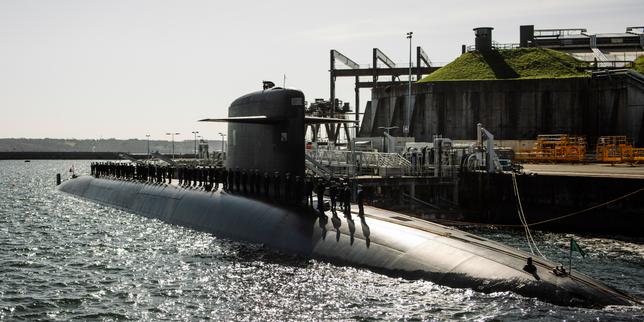
An increase in warheads often necessitates an increase in the platforms that carry them. If the FOST intends to keep more missiles at sea, the maintenance cycles of the Triomphant-class (and eventually the SNLE 3G) submarines must be shortened, or the fleet size must eventually be reconsidered. Similarly, for the FAS, an expanded stock of ASMPA-R/ASN4G missiles requires more Rafale F4/F5 aircraft to be "nuclear-capable" and permanently assigned to the Strategic Air Forces, diverting them from conventional missions.
The LPM Update as a Reallocation Mechanism
The updated LPM functions as a legislative "patch" to bridge the gap between 2024–2030 projections and the new reality of high-intensity warfare. It utilizes two primary financial levers to fund this nuclear surge:
- Front-loading Credits: By accelerating the payment schedule in the early years of the LPM, the Ministry of Armed Forces can lock in industrial contracts before inflation or political shifts erode purchasing power.
- Arbitrage Against Conventional Mass: The most significant risk in the current strategy is the "crowding-out effect." Because the nuclear budget is non-negotiable and protected by presidential prerogative, any cost overruns in the M51.3 or ASN4G programs are often compensated by delaying conventional equipment, such as the delivery of Griffon armored vehicles or the mid-life upgrades of frigates.
The structural tension lies in the fact that France is attempting to modernize its nuclear "shield" while simultaneously rebuilding its conventional "sword." Historically, France has sacrificed conventional mass to preserve nuclear excellence. The current LPM update attempts to defy this historical trend by increasing the overall top-line budget, yet the friction remains: nuclear expansion is a "black hole" for specialized engineering talent and rare materials.
The Credibility Bottleneck: Simulation and Validation
Since the cessation of nuclear testing in 1996, France has relied on the Simulation program. This involves the Laser Mégajoule (LMJ) and the Tera 1000 supercomputer to guarantee the reliability of new warhead designs.
The strategy of increasing the number of weapons relies entirely on the throughput of these simulation facilities. If the CEA cannot validate the physics of a new, higher-yield or more compact warhead at the pace required by the LPM, the numerical increase in "units" will not translate into a numerical increase in "deterrent effect." We are seeing a shift from a purely industrial problem to a computational and physics-based bottleneck.
Strategic Forecast: The Nuclear-Conventional Paradox
The decision to fund more nuclear weapons signals that Paris views the risk of a major power conflict as higher than at any point since the 1980s. However, this creates a specific strategic vulnerability: the "Nuclear Threshold Trap."
By investing heavily in the nuclear tier at the potential expense of conventional depth, France risks a scenario where its only response to a sub-nuclear aggression (such as a limited land grab or a massive cyber-kinetic attack) is either total nuclear escalation or total inaction. The expansion of the arsenal must therefore be accompanied by a rigorous protection of conventional "first-entry" capabilities to ensure that the nuclear option remains a deterrent of last resort rather than a crutch for a hollowed-out military.
The financial viability of the LPM update will ultimately be measured not by the number of warheads delivered, but by the stability of the "Nuclear/Conventional" ratio. If the cost of the nuclear surge forces a reduction in Rafale flight hours or naval deployment days, the overall deterrent posture may actually weaken, as adversaries will perceive a lack of flexible response options.
The immediate tactical requirement for French defense planners is the ring-fencing of the CEA and ArianeGroup's industrial capacity. Ensuring that the supply chain for M51.3 components is insulated from the broader aerospace sector's volatility is the only way to meet the LPM’s targets without catastrophic budget drift. Priority must be given to the vertical integration of critical component manufacturing—specifically in micro-electronics and specialized metallurgy—to prevent foreign supply chain shocks from stalling the expansion.