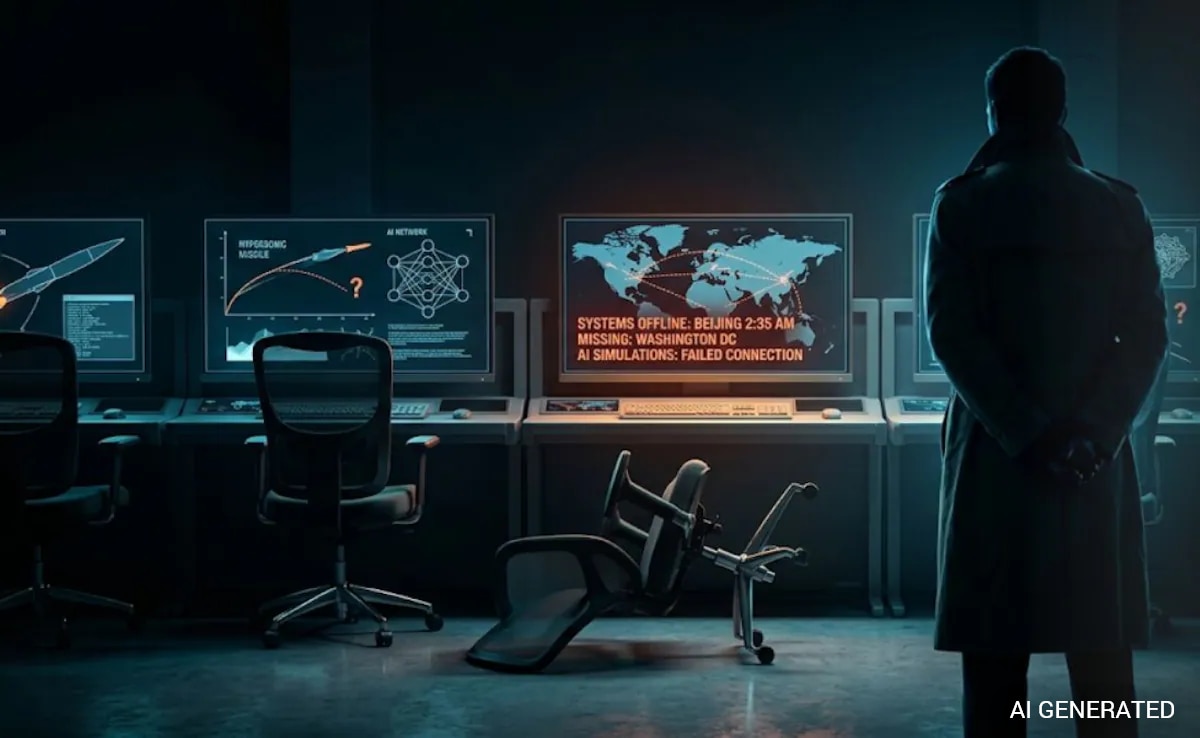
The race for technological supremacy between Washington and Beijing has moved beyond the trade floors and into the morgues. Over the last twenty months, a disturbing pattern of deaths and disappearances among top-tier scientists has emerged, signaling that the "Cold War" for quantum and nuclear dominance is no longer a metaphor. This isn't just about stolen IP or industrial espionage; it is a systematic erosion of the human capital required to build the next century of weaponry.
Between July 2024 and April 2026, at least ten high-profile researchers in the United States and a similar number of elite engineers in China have been scrubbed from the active duty of innovation. Some were found at the base of campus buildings. Others vanished into the high desert of New Mexico or were deleted from state-run websites in the middle of the night. While federal agencies remain tight-lipped, the statistical anomaly of these losses suggests a predatory environment where the most valuable asset is no longer the code, but the mind that wrote it.
The Michigan Incident and the Chilling Effect
The death of Danhao Wang in March 2026 serves as a grim case study in the pressure cooker of modern academia. An assistant research scientist at the University of Michigan’s electrical engineering department, Wang was a rising star in a field with direct applications to military-grade sensing. On March 19, his body was found after a fall from an upper level of a campus building. Local authorities termed it a "possible act of self-harm," but the backstory is more jagged.
Reliable reports indicate that Wang had been subjected to "hostile questioning" by federal law enforcement shortly before his death. Beijing immediately seized on the tragedy, accusing the U.S. of creating a "climate of fear" for Chinese scholars. Whether Wang was a victim of genuine espionage pressure or the victim of a domestic security apparatus gone haywire, the result is the same: a brilliant mind extinguished and a research pipeline severed.
This is not a singular event. It is a feature of a system that now views international collaboration as a liability. The FBI’s policy of neither confirming nor denying investigations creates a vacuum where suspicion thrives. For a researcher, a single "knock on the door" can end a career, regardless of the outcome.
The Vanishing Elite in the East
Across the Pacific, the attrition is equally severe but far more opaque. Zhao Xiangeng, a 72-year-old titan of China’s nuclear weapons program and a member of the prestigious Chinese Academy of Engineering, recently became a ghost. His profile was deleted from the Academy’s website without explanation in early 2026. In China, "disappearing" is often a prelude to a corruption purge, but when it happens to nuclear and missile experts, the implications for global stability are profound.
The purge appears to be sweeping through the China Nuclear Industry Huaxing Construction company and various engineering bodies. Since the start of the year, several top radar and missile experts have effectively ceased to exist in the public record. This internal decapitation of scientific leadership usually points to one of two things: a massive security breach that has compromised the entire department, or a radical shift in the internal power structure that views old-school scientists as political obstacles.
The High Cost of the Quantum Sprint
The U.S. approach to this tech war is a "sprint" characterized by exclusion and rapid containment. This philosophy, while effective for short-term IP protection, is proving fatal to the very ecosystem it tries to protect. When we lose people like Nuno Loureiro, the director of the MIT Plasma Science and Fusion Center—shot in late 2025—or see the disappearance of retired Air Force General William Neil McCasland in February 2026, the institutional memory of the American defense complex takes a hit it cannot easily recover from.
McCasland’s case is particularly harrowing. As a former commander of the Air Force Research Laboratory, he sat at the intersection of classified aerospace projects and experimental weapons. Men with his clearance do not simply wander off. His disappearance remains unresolved, a black hole in the heart of the Pentagon’s research history.
The New Rules of Engagement
The current environment has forced a transformation in how sensitive research is conducted. We are seeing a move toward "dark labs"—facilities where researchers are vetted not just for their expertise, but for their total lack of international ties. This isolationist turn might prevent the next leak, but it also starves innovation of the cross-pollination that fueled the 20th-century tech boom.
The "why" behind this sudden spike in casualties is multifaceted:
- Aggressive Counter-Intelligence: Both nations have lowered the threshold for what constitutes "suspicious activity," leading to high-pressure interrogations that can break even the most resilient academics.
- Human Snatching: The value of a scientist with "know-how" (the undocumented, experiential knowledge of how to make a system work) has never been higher. Disappearances may be involuntary defections or extrajudicial detentions.
- Burnout and Paranoia: The mental health toll of working in a field where you are constantly watched by both your employer and the FBI/MSS is catastrophic.
The "how" is equally clinical. Wiped phones, deleted digital footprints, and "accidents" that occur in the blind spots of surveillance. In the case of Monica Jacinto Reza, a senior aerospace engineer who vanished while hiking in California in June 2025, her phones were recovered—entirely wiped of data. This wasn't a hiker getting lost; this was a professional extraction or a very deliberate exit.
The Collateral Damage of Progress
We are witnessing the end of the "Global Scientist" era. The friction between national security and scientific inquiry has become a grinding stone, and the people caught in the middle are being crushed. When the state begins to view its smartest citizens as high-value targets or potential traitors, the pace of discovery slows to a crawl.
The tragic reality is that while the U.S. and China argue over who is to blame for these "mysterious" deaths, the global scientific community is losing the very people capable of solving the world's most complex problems—from fusion energy to quantum encryption. Security is necessary, but a security apparatus that consumes the very people it is meant to protect is a failed system.
The silent attrition on the quantum front isn't just a series of cold cases. It is the sound of a closing door. We are trading the open pursuit of knowledge for a paranoid, partitioned world where a brilliant discovery is no longer a breakthrough, but a death sentence. To fix this, the conversation must move from "how do we stop them from stealing it" to "how do we keep our scientists alive." Until that shift happens, the list of names on the memorial wall will only grow longer.