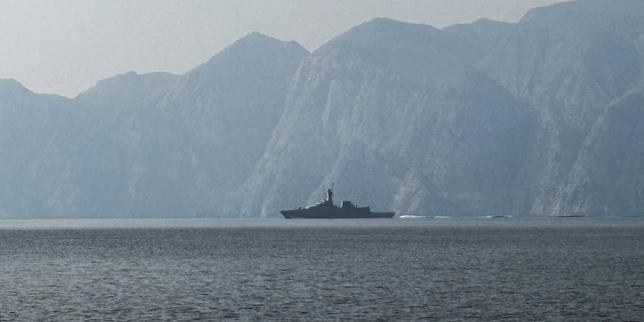
A single, jagged line on a maritime chart defines the difference between a functioning global economy and a descent into pre-industrial chaos. It is the Strait of Hormuz. At its narrowest point, the shipping lanes are only two miles wide in each direction. If you were standing on the deck of a ULCC—an Ultra Large Crude Carrier—you could almost feel the weight of the Iranian and Omani coastlines pressing in on you. This is the world’s jugular vein.
Most people don't think about the Strait until the price of a gallon of gas jumps forty cents overnight. But for someone like Captain Elias, a hypothetical but statistically accurate veteran of the merchant marines, the Strait is a place of tactile tension. He feels it in the slight vibration of the bridge under his boots. He sees it in the gray silhouettes of fast-attack craft darting between the waves. He knows that beneath his feet sit two million barrels of crude oil, a cargo valued at roughly 160 million dollars, destined for a refinery in Chiba or Rotterdam.
If those lanes close, the world stops moving.
The Arithmetic of Interruption
The math is brutal and unforgiving. Roughly 21 million barrels of oil pass through this narrow gateway every single day. That represents about 21% of global petroleum liquid consumption. To visualize that, imagine a line of tanker trucks stretching from New York City to Los Angeles and back again, four times over. Now imagine someone suddenly slamming a gate shut across the highway.
When the competitor reports on "regional trade perturbations," they are using sterile language to describe a cardiac arrest of the global supply chain. This isn't just about oil. It is about Liquefied Natural Gas (LNG). Qatar, one of the world’s largest exporters of LNG, sends nearly all of its output through this corridor. If the Strait is blocked, the lights don't just flicker in Tokyo or London; they go out.
Consider the "Invisible Cargo." We often focus on what comes out of the Persian Gulf, but we forget what goes in. The Gulf nations import almost everything: grain from the Midwest, luxury cars from Germany, microchips from Taiwan, and medicine from Switzerland. A blockage creates a vacuum. It’s a double-edged sword that hacks at both the producer’s wallet and the consumer’s survival.
The Ghost of 1988
History isn't a straight line; it's a circle. During the "Tanker War" of the 1980s, over 500 merchant vessels were attacked in these waters. Sailors slept in lifejackets. They painted their ships' names in giant letters on the hulls, hoping for a mercy that rarely came from Silkworm missiles or sea mines.
Today, the threat has evolved from heavy steel to silent software and cheap drones. A blockage wouldn't necessarily require a sunken ship. It only requires a spike in insurance premiums. The moment Lloyd’s of London declares the Strait a "war zone," the cost of shipping a single barrel of oil doesn't just rise—it explodes. A shipping company that paid 30,000 dollars a day for insurance might suddenly find itself looking at 300,000 dollars.
Most companies simply cannot absorb that cost. They anchor their fleets. They wait. And while they wait, the clock ticks for every factory in Europe and every commuter in America.
The Domino Effect on the Kitchen Table
Let’s look at the mechanics of the collapse. It starts at the pump, but it ends at the grocery store. Modern agriculture is essentially the process of turning fossil fuels into food. Fertilizers are made from natural gas. Tractors run on diesel. Refrigerated trucks require constant power.
If the Strait of Hormuz is obstructed for even two weeks, the price of a loaf of bread in a suburb of Chicago begins to climb. Not because the wheat is missing, but because the energy required to move that wheat has become a luxury.
Metaphors often fail to capture the sheer scale of this dependency. Think of the global economy as a complex, high-speed engine. The Strait of Hormuz is the oil filter. You can run the engine for a few minutes with a clogged filter, but eventually, the friction generates heat. The heat warps the metal. The engine seizes.
The Myth of the Pipeline Bypass
Critics often point to pipelines across Saudi Arabia or the United Arab Emirates as a safety net. They exist, certainly. The East-West Pipeline in Saudi Arabia can move about 5 million barrels a day to the Red Sea. But 5 million is not 21 million. It’s a band-aid on a femoral artery wound.
Furthermore, these pipelines are fixed targets. They are vulnerable to the same geopolitical tensions that threaten the water. There is no "Plan B" that doesn't involve a massive, systemic contraction of global wealth. We are tethered to the water. We are tethered to those six miles of navigable sea.
The Psychological Toll of the Unknown
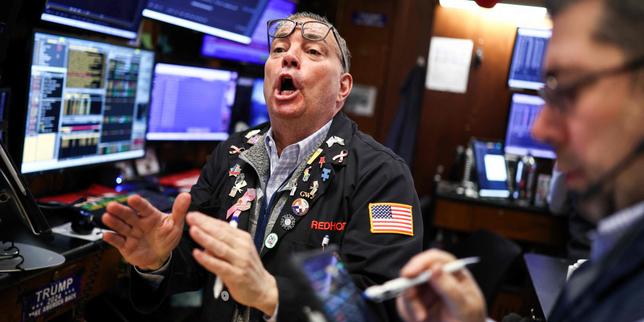
The real danger isn't just the physical blockage; it's the uncertainty. Markets loathe a vacuum. The moment a tanker is struck by a drone or a mine is spotted near the Musandam Peninsula, the "fear premium" kicks in. Traders in New York and London begin betting on the worst-case scenario.
This isn't speculation; it's a reflex.
For the crew on the water, the experience is more visceral. Imagine being Captain Elias. You are navigating a vessel the size of an aircraft carrier through a space barely wider than a city street. You are surrounded by geopolitical posturing. You are a pawn in a game played by people in air-conditioned offices thousands of miles away. Your "workplace" is now a flashpoint.
The stress of this reality filters down. It affects the hiring of mariners, the routes of shipping giants like Maersk and MSC, and the strategic reserves of entire nations. We are living in a house of cards, and the Strait is the bottom row.
Beyond the Barrel
We must look past the oil. The electronics you are using to read this, the clothes you are wearing, the very infrastructure of the digital age—all of it relies on the stability of maritime trade. While the Strait of Hormuz is primary for energy, its closure would force a massive rerouting of all commercial traffic in the region.
The Port of Jebel Ali in Dubai is one of the busiest in the world. It is the transshipment hub for the entire Middle East. If the Strait is closed, Jebel Ali becomes a ghost town. The ripple effect hits every port from Singapore to Hamburg. Containers stack up. Perishables rot. The "just-in-time" delivery model that defines our modern existence turns into a "never-on-time" disaster.
The Fragility of the Blue Frontier
We like to believe we have conquered nature and distance. We have satellites, 5G, and AI. Yet, our entire civilization remains subservient to a few fathoms of salt water and the political whims of the nations that border them.
The "perturbations" mentioned in standard financial reports are, in reality, the tremors of a potential seismic shift. If the gate slams shut, the silence that follows will be the loudest sound in the history of modern commerce.
A lone tanker sits at the entrance to the Strait. The sun sets over the Iranian mountains, casting a long, amber shadow across the water. The crew is quiet. The engines hum. They are carrying the lifeblood of a world that chooses not to look at how thin the straw really is. Every revolution of the propeller is a heartbeat. Every mile gained is a reprieve for a global economy that is only ever one bad day away from a standstill.