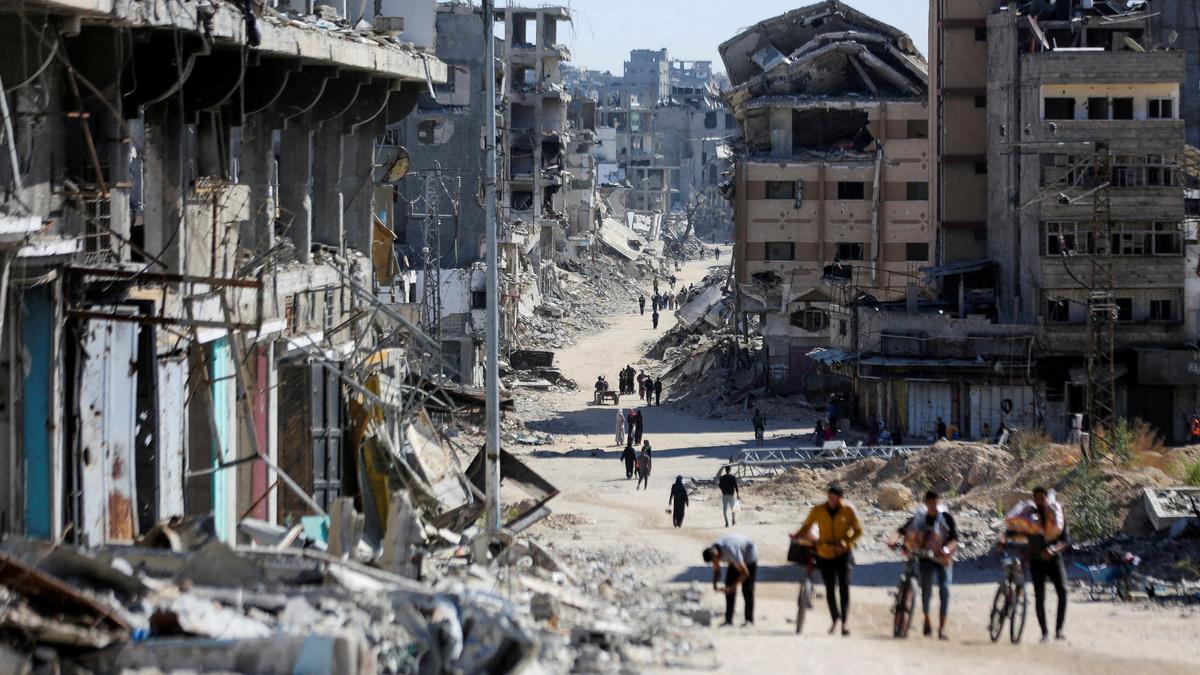
Headline fatigue is a clinical condition. Every morning, the digital tickers refresh with a predictable cadence: five dead here, twelve there, a strike on a residential block, a statement from a local authority. The competitor’s report on the Gaza civil defence update is a masterclass in the "lazy consensus" of modern conflict reporting. It treats war like a weather report—sporadic, unfortunate, and entirely devoid of the underlying mechanics that make the engine turn.
Reporting that "at least five" died in an Israeli strike is technically accurate and intellectually bankrupt. It tells you nothing about the shifting geometry of urban warfare or the tactical desperation that leads to these specific points of contact. If we are going to look at the meat grinder, we need to stop counting the sparks and start looking at the fuel.
The Body Count Fallacy
Standard reporting relies on a binary of victimhood. There is a strike, there are casualties, and there is a quote from an official body—in this case, the Gaza civil defence. We consume these numbers as if they are static variables in a vacuum. They aren't.
In high-intensity urban combat, numbers are used as currency. When a source provides a death toll within minutes of an impact, they are performing a political act, not a forensic one. The rush to print these figures ignores the fundamental reality of structural collapses. I have seen recovery operations where it takes days to identify remains, yet the digital press demands a number before the dust has even settled.
When you read "at least five," you are seeing the result of a pressurized information environment where speed has murdered accuracy. We have traded the "why" for the "how many," and in doing so, we’ve lost the ability to understand the strategic intent behind the kinetic action.
Tactical Necessity vs. Optical Disaster
The "lazy consensus" suggests that strikes happen in a vacuum of malice or error. The nuance that the mainstream press refuses to touch is the brutal logic of the target set. In the dense corridors of the Gaza Strip, the distinction between civilian infrastructure and military utility has been erased—not by accident, but by design.
Urban warfare in the 21st century is defined by the "cluttered environment." Imagine a scenario where a command node is situated three floors beneath a family apartment. The moral calculus for the commander ordering the strike is a nightmare; the reporting on that strike, however, is a breeze. The reporter simply writes "five dead in a residential building."
This creates a massive gap in public understanding. By failing to report on the reason for the strike—or the specific military hardware likely housed in the vicinity—the media acts as a force multiplier for the side that benefits from the optics of tragedy. We are watching a high-stakes chess match, but the news is only describing the color of the pieces being removed from the board.
The Myth of the Neutral Source
We need to talk about the "civil defence" as a source. In any other conflict, a government-aligned agency would be treated with extreme skepticism. Yet, in this theater, their word is often taken as the baseline reality.
I’ve spent enough time around operational intelligence to know that every "official" statement is a curated piece of a larger narrative. The Gaza civil defence is an arm of the governing body. To cite them without the caveat of their political alignment isn't journalism; it’s transcription.
When a report fails to differentiate between combatants and non-combatants, it’s a failure of expertise. Modern munitions are precise, but the physics of a 500-lb bomb in a concrete alleyway don't care about your press release. By lumping every casualty into a single, undifferentiated bucket, the media obscures the true cost of the war and the specific nature of the insurgency.
Logistics of the Rubble
Let’s get technical. If a strike kills five people in a city as densely populated as Gaza, that is—from a purely ballistic standpoint—an incredibly contained event. This suggests a high degree of intelligence and a specific, low-yield munition choice.
The competitor's article misses this entirely. They paint a picture of indiscriminate carnage, but the data of "five dead" actually points to a surgically targeted operation. If the goal were mass casualty, the numbers would be in the hundreds. The restraint, or the lack thereof, is the actual story.
- Targeting Cycles: How long was the building surveilled?
- Munition Choice: Was it a thermobaric charge or a kinetic slug?
- Secondary Explosions: Did the "five dead" occur because of the initial hit or the hidden cache of rockets that cooked off afterward?
The mainstream media doesn't ask these questions because they don't know they exist. They are stuck in the 1940s mindset of carpet bombing while the world has moved on to algorithmic warfare.
Stop Asking if it’s Sad; Ask if it’s Effective
This is the part that gets people's blood up, but it is the truth: War is not a humanitarian project. When you see a strike report, the "People Also Ask" section of your brain should not be "How can we stop this?" but "What was the objective, and was it met?"
If the objective was to decapitate a cell and five people died in the process, the military logic considers that a success. The media’s refusal to engage with this cold-blooded reality makes the public more naive, not more informed. We are being fed a diet of emotional triggers that prevent us from seeing the long-term geopolitical shifts occurring under our feet.
The conventional wisdom says we should feel more. I say we should think more. We should demand to know the specific frequency of the signals intelligence that led to that specific coordinate. We should demand to see the battle damage assessment (BDA) rather than just the casualty list.
The Cost of the "Clean" Narrative
The desire for a clean narrative—the big bad wolf vs. the helpless victim—is the enemy of truth. This conflict is a muddy, grinding, technical horror show where both sides are deeply invested in your emotional reaction.
Every time you click on a headline that focuses solely on a snapshot of death without the surrounding tactical context, you are subsidizing lazy journalism. You are encouraging the press to stay on the surface because the depths are too politically dangerous to swim in.
The reality of the strike that killed "at least five" is that it was likely one tiny move in a massive, invisible war for tunnel control, supply line disruption, and psychological dominance. If you aren't talking about the sensors, the drones, the human intelligence networks, and the architectural vulnerabilities of the strip, you aren't talking about the war. You’re just talking about the weather.
Next time you see a casualty count, ignore the number. Look for the "why" buried in the third paragraph. If it isn't there, throw the article away. You are being manipulated by an industry that has replaced investigation with a ledger of grief.
Stop looking at the blood and start looking at the map.