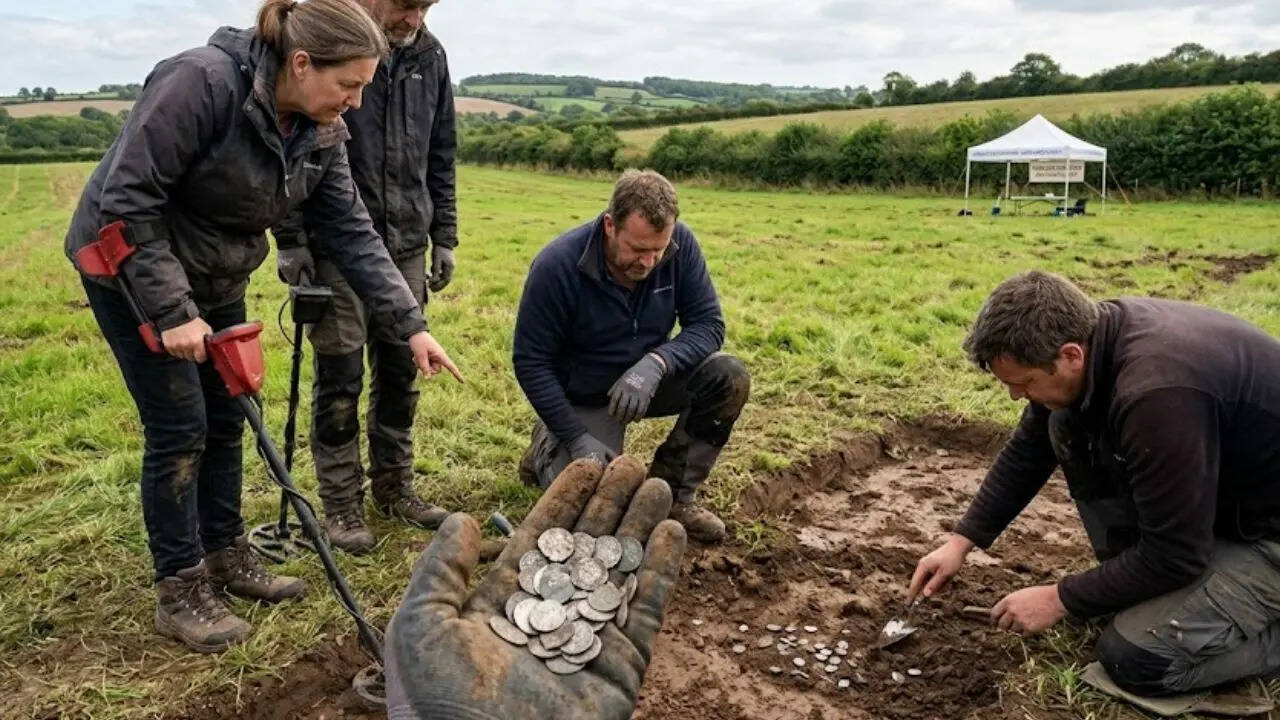
The discovery of 63 Anglo-Saxon coins in a Worcestershire field isn’t a romantic "treasure alert." It is a crime scene of economic desperation.
Mainstream media loves the narrative of the "Viking Age hoard." They want you to imagine a terrified monk or a local lord burying his life savings as longships appeared on the horizon, intending to return once the dust settled. It’s a nice story. It sells museum tickets. It’s also largely a fantasy that ignores how money actually moved in the 9th and 10th centuries.
When you see a cluster of silver pennies from the reigns of Alfred the Great or Æthelred the Unready, you aren't looking at "lost wealth." You are looking at a localized systemic collapse.
The Myth of the Viking Boogeyman
The lazy consensus suggests that these hoards exist because of external violence. The logic is simple: Vikings arrive, people hide money, people die, money stays hidden.
But look at the data. Many of the largest hoards found in the UK and Scandinavia contain coins from periods of relative peace or from regions nowhere near the front lines of Norse incursions. If burying money was purely a response to raiding, we would see a perfect correlation between Viking pathways and pit locations. We don't.
What we see instead is liquidity entrapment.
In the Anglo-Saxon economy, silver was the only game in town. There was no credit. There was no paper. If the local market failed or if the king demanded a "Danegeld" (protection money) that drained the local supply, the velocity of money hit zero. People didn't bury silver because they were afraid of a sword; they buried it because the silver had ceased to function as a medium of exchange. It was dead capital.
The Portability Fallacy
Archaeologists often treat these finds as "savings accounts." This is a fundamental misunderstanding of 10th-century wealth management.
Gold and silver in the early medieval period were "heavy" in more than just physical weight. They were politically charged. To hold 63 silver pennies in Worcestershire was to hold a massive amount of social gravity. In an era where a single sheep might cost a few pennies, sixty-three coins represented a small fortune—enough to buy a modest farm or pay a small militia.
You don't just "lose" that in a field. You bury it because you cannot spend it without attracting the wrong kind of attention. These hoards are evidence of an underground economy that failed to resurface. They represent a "black market" that stayed black.
I’ve spent years looking at how people hide assets during currency devaluations. The behavior hasn't changed in a thousand years. When the state (in this case, the Wessex or Mercian crown) starts messing with the silver content or the weight of the coinage, the "good" money goes into the ground. This is Gresham’s Law in action: "Bad money drives out good."
If the King issues new, debased coins, you bury the old, high-purity ones. The Worcestershire 63 aren't a "Viking hoard"—they are likely a hedge against royal inflation that the owner didn't live long enough to cash in.
Stop Obsessing Over the "Viking" Label
The "Viking Age" is a convenient bucket for everything that happened between 793 and 1066, but it obscures the internal decay of the Anglo-Saxon kingdoms. By framing every coin find as a "link to the Vikings," we ignore the brutal reality of the Anglo-Saxon tax man.
The late Anglo-Saxon state was one of the most sophisticated—and extractive—bureaucracies in Europe. They re-coined the entire country's supply every few years. You were forced to bring your old coins to the mint, pay a massive fee, and receive fewer, new coins in return.
If you were a farmer in Worcestershire and you managed to scrape together 60+ coins, the last thing you wanted to do was take them to a royal mint to be taxed into oblivion. You put them in a pot. You waited for the tax collector to pass.
The Amateur Detectorist Problem
We need to address the "Treasure Act" culture that turns every muddy find into a national celebration.
When a hobbyist finds a hoard, the focus is immediately on the "value" and the "history." But the act of extraction often destroys the only thing that actually matters: the stratigraphy.
Context is everything. Was the hoard wrapped in a specific textile? Was it placed near a boundary marker? Was it buried under a hearth? Most "treasure" stories ignore these details in favor of a high-res photo of a shiny coin. We are losing the "why" to satisfy our craving for the "what."
If you find a coin, you aren't a hero of history. You are a data-thief unless you leave it exactly where it is and call a professional who understands that the soil around the coin is more valuable than the silver itself.
The Brutal Reality of Wealth Preservation
Imagine a scenario where the modern banking system shuts down for six months. You have cash, but the shops only take a new digital currency issued by a volatile government. You hide your cash. You die in a mundane flu outbreak. A thousand years later, someone finds your "hoard" and assumes you were hiding from a terrorist invasion.
That is the Worcestershire find. It isn't a story of glorious battle. It's a story of a guy who couldn't find a way to spend his money without getting ripped off by his own king.
Your Actionable Advice for History
If you want to actually understand the past, stop reading "treasure" headlines. They are the clickbait of the social sciences. Instead, look for:
- Mintage Weights: Compare the weight of the hoard coins to the official standard of the time. If they are heavier, it’s a tax dodge, not a Viking defense.
- Wear Patterns: Are the coins "mint state"? If they show no wear, they were pulled from circulation immediately. This suggests a sudden, panicked hoarding event—likely economic, not military.
- Soil Composition: Look for evidence of organic containers. A leather pouch suggests "ready cash" for flight. A ceramic pot suggests "long-term storage" (a bank).
The Worcestershire 63 is a failure of the 10th-century financial system. It is a reminder that when the state becomes too extractive and the markets too volatile, wealth disappears into the dirt.
Stop romanticizing the silver. Start questioning why it was left behind. The truth isn't in the Viking longships; it's in the ledger books of a dying kingdom.
Stop looking for invaders and start looking for the tax collectors.