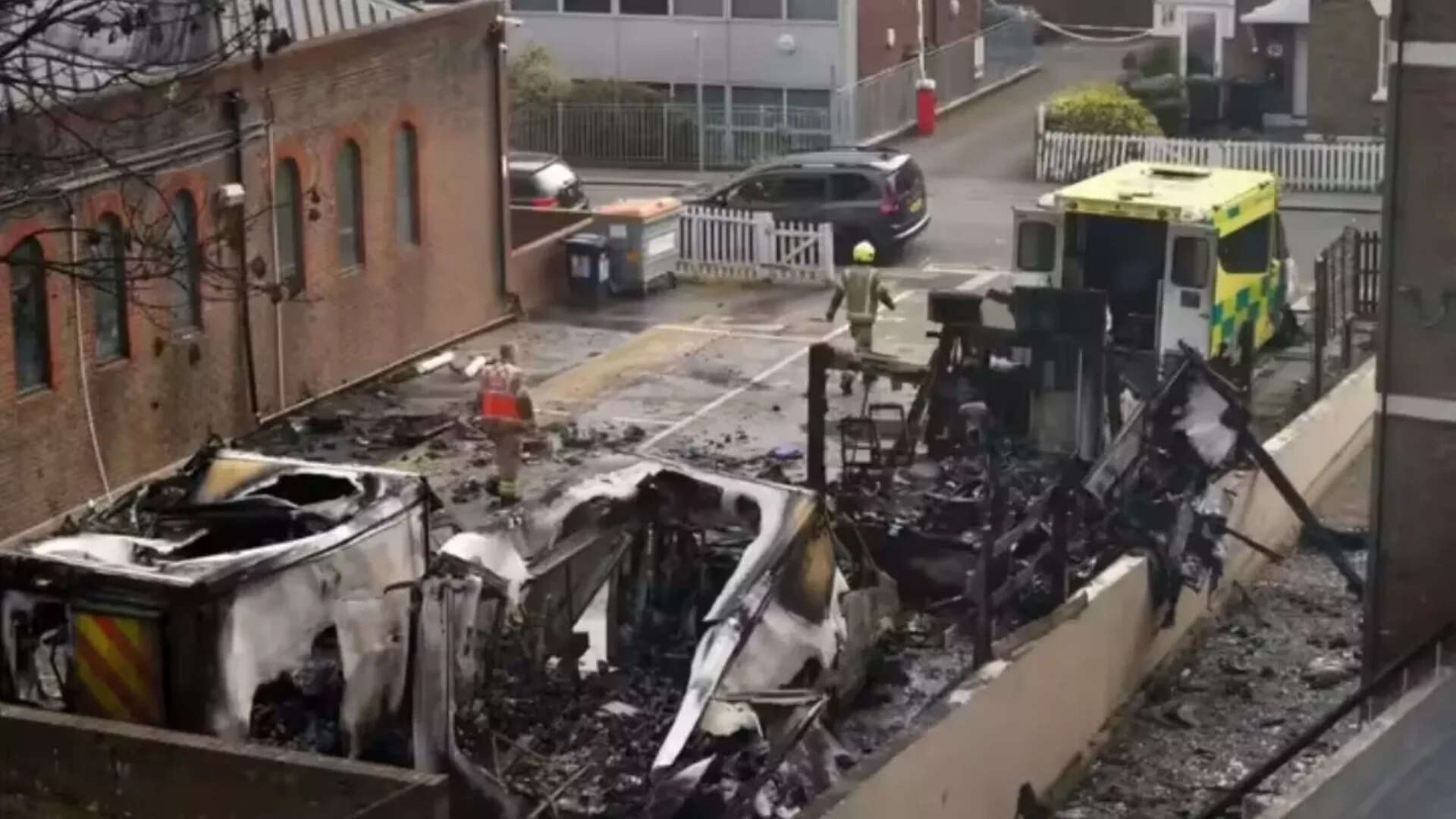
The arrest of two men in North London following an arson attack on a fleet of private Jewish ambulances is not merely a local police matter. It is a calculated strike against a critical piece of community infrastructure. When the Hatzola emergency garage in Stamford Hill was set ablaze, the intent went beyond simple property damage. This was an attempt to dismantle a lifeline.
Early reports focused on the immediate visuals of charred vehicles and police tape. However, the reality of the situation involves a sophisticated emergency response network that serves one of Europe's most densely populated Jewish neighborhoods. By targeting the Hatzola ambulances, the perpetrators struck at a service that often reaches patients faster than the state-funded National Health Service (NHS). The Metropolitan Police have since categorized the incident as a hate crime, but for the residents of Hackney and Haringey, it feels more like a targeted siege on their safety.
The Strategic Selection of Hatzola as a Target
Hatzola is not a typical ambulance service. It is a volunteer-led organization that operates on the periphery of the official emergency services while remaining deeply integrated into the local culture. They are the first responders for thousands. By disabling these vehicles, the attackers created a localized vacuum in emergency medical care.
The logistics of the attack suggest more than a random act of vandalism. To successfully set fire to multiple specialized vehicles in a secure or semi-secure environment requires a level of premeditation that shifts the narrative from "antisemitic incident" to "targeted sabotage." This wasn't a brick through a window; it was an effort to ensure that when a heart attack or a respiratory failure occurs in a specific street, the help that usually arrives in three minutes is no longer there.
Beyond the Headline Arrests
The Metropolitan Police recently confirmed the detention of two suspects, aged 21 and 22, on suspicion of arson and a religiously aggravated hate crime. While these arrests offer a temporary reprieve for a rattled community, they do not address the underlying shift in tactics regarding hate-motivated violence in the UK.
For years, antisemitic incidents in London have fluctuated between verbal abuse and physical street assaults. The shift toward infrastructure-based attacks signals a more dangerous evolution. We are seeing a move toward "soft-target" urban terrorism, where the goal is to make the daily rhythm of life for a minority group feel untenable. When you cannot trust that an ambulance will be there because the fleet has been incinerated, the psychological toll far outweighs the financial cost of the vehicles.
The Financial and Operational Burden
Replacing a modern ambulance is an ordeal of red tape and high costs. It is not as simple as buying a van.
- Specialized Medical Equipment: Each unit contains thousands of pounds worth of defibrillators, oxygen systems, and diagnostic tools.
- Custom Conversions: The vehicles must meet stringent UK road and health regulations, a process that can take months.
- Insurance Complications: When an incident is labeled a hate crime or a "terrorist" act, insurance payouts can become bogged down in legal definitions, leaving the community to fundraise for replacements in the interim.
This creates a period of vulnerability. Even with two people in custody, the Hatzola fleet remains depleted, and the community remains on high alert.
The Failure of Deterrence
The UK has some of the most comprehensive hate crime laws in the world. Yet, they are failing to act as a deterrent for this specific brand of ideological arson. The current legal framework treats the "religiously aggravated" element as a sentencing uplift, but the actual prevention of these crimes is lagging behind the rhetoric.
Police patrols in Stamford Hill and Golders Green are often increased following such attacks, but this is a reactive posture. It is "whack-a-mole" policing. True security for these neighborhoods would require a shift in intelligence gathering that treats these incidents not as isolated outbursts, but as part of a broader, radicalized pattern of behavior that is increasingly moving from the digital world into the physical one.
The Role of Digital Radicalization
Investigative leads often point back to online forums where "direct action" is glorified. While the police have not yet linked these specific suspects to a particular cell or movement, the pattern of attacking community symbols is a hallmark of radicalized youth. The suspects’ ages—21 and 22—are telling. They belong to a generation that has grown up in a digital ecosystem where antisemitic tropes are frequently recycled and repackaged as political commentary.
When these tropes move from a screen to a gasoline canister, the social contract is effectively broken. The arrests are a starting point, but the investigation needs to look at the digital trail that led these men to a specific garage in the middle of the night.
The Resilience Trap
There is a tendency in British media to praise the "resilience" of targeted communities. While the Jewish community in London is indeed resilient, the constant need to prove it is a symptom of a systemic failure. Resilience should not be a requirement for living in a modern democracy.
The Hatzola volunteers were back on the streets the morning after the fire. They used older vehicles and coordinated with the London Ambulance Service to ensure no calls went unanswered. This is commendable, but it also masks the severity of the threat. If the state relies on the victim's ability to "bounce back," it avoids the harder conversation about why the protection of these citizens failed in the first place.
Why the Current Narrative is Incomplete
Most outlets are reporting this as a "unfortunate incident" resolved by swift police work. This is a sanitized view.
To understand the gravity, one must look at the geography of the attack. Stamford Hill is home to one of the largest Orthodox Jewish populations in the world outside of Israel and New York. It is a high-visibility target. Attacking an ambulance there is a message sent to every Jewish person in the country: Your most vital services are not safe.
We must also consider the timing. This attack occurred during a period of heightened international tension, yet the victims are British citizens going about their lives. The conflation of global politics with local emergency services is a dangerous precedent that the UK legal system is currently ill-equipped to handle.
Looking at the Evidence of Intent
The forensic reality of the scene in North London tells a specific story.
- Multiple Ignition Points: This suggests a coordinated effort to ensure total loss of the fleet, rather than a single fire that spread accidentally.
- Timing: Executed in the early hours when response times are naturally slower, and witnesses are fewer.
- Target Choice: Choosing ambulances—vehicles that symbolize help and neutrality—is a deliberate choice to maximize the shock factor.
This was a mission. Whether it was a mission assigned by a group or a self-assigned one fueled by online vitriol, the result is the same: the weaponization of fire against a vulnerable population.
The Path to Real Security
Increasing the number of CCTV cameras or adding more police officers on the beat is the standard response, but it is insufficient. The real fix involves a multi-pronged approach that the current administration has been slow to adopt.
First, there must be a reclassification of attacks on emergency infrastructure. If you attack an ambulance—whether it is NHS or a private community service like Hatzola—the penalties should be significantly harsher than standard arson. These vehicles are protected under the spirit of international humanitarian law in conflict zones; they should be equally protected in the streets of London.
Second, the funding for community security needs to be stabilized and expanded. Currently, much of the security for Jewish schools and synagogues is subsidized by the Community Security Trust (CST) and private donations. This is effectively a "security tax" on being Jewish in Britain. The state must take a more proactive role in securing these perimeters rather than leaving it to the victims to protect themselves.
Finally, the prosecution of the two men currently in custody must be transparent and rigorous. A "slap on the wrist" or a plea deal that ignores the hate crime element would be a green light to other potential bad actors. The justice system needs to demonstrate that the cost of such an attack is higher than any perceived ideological "win."
The charred remains of the Hatzola ambulances are a stark reminder that hate is not a theoretical concept debated in Parliament. It is a physical force that melts metal and endangers lives. The arrests are a necessary first step, but they are miles away from a solution.
Check the security protocols of your local community centers and ensure that emergency access points are not only monitored by cameras but also protected by physical barriers that prevent unauthorized approach during high-risk hours.