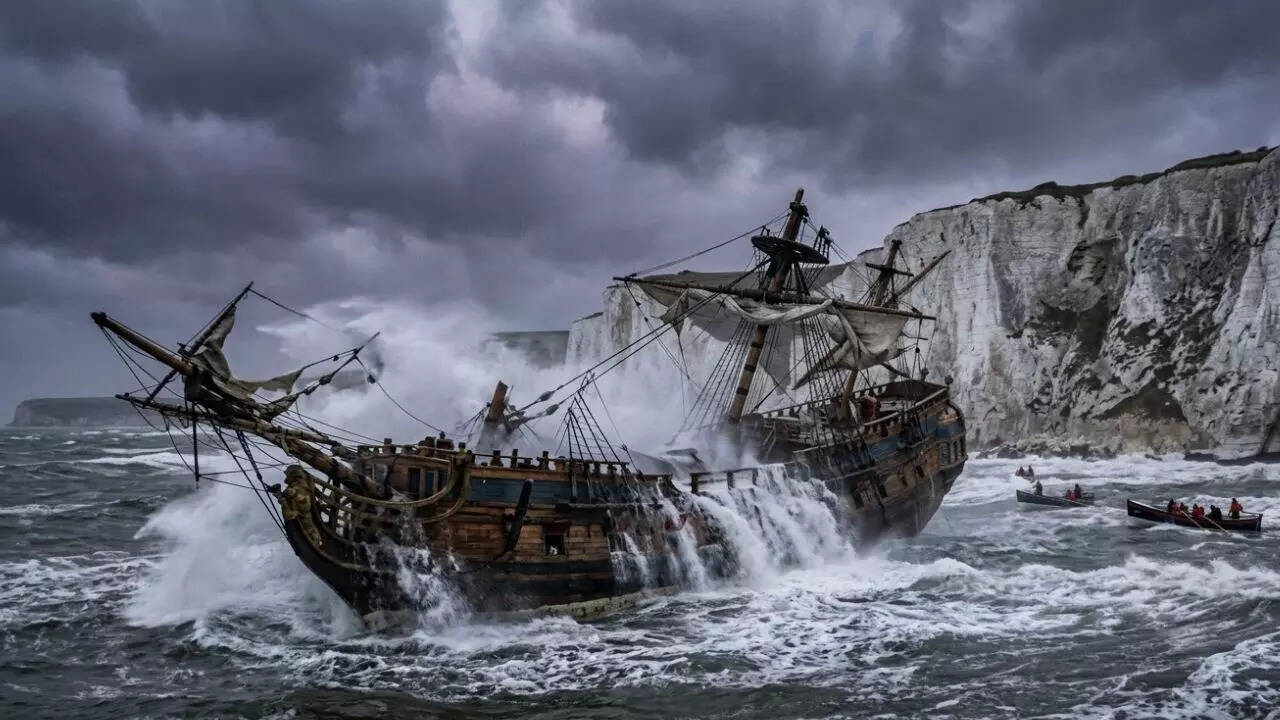
The ocean doesn't just swallow ships. It preserves stories in a way that dry land never could. When researchers recently pinpointed the remains of a 280-year-old shipwreck off the coast of England, the headlines screamed about "silver bones" and lost treasure. But if you think this is just a real-life version of a pirate movie, you're missing the point. This find is a brutal, cold reminder of how the British Empire actually functioned and the sheer scale of the risks sailors took in the 1700s.
The ship in question is the HMS Victory—not the one Lord Nelson commanded at Trafalgar, but its predecessor. This was a first-rate ship of the line, a floating fortress that vanished in a storm in 1744. For nearly three centuries, nobody knew where it went. When Odyssey Marine Exploration finally located the site, they didn't just find wood and nails. They found a graveyard of mid-18th-century technology and a staggering amount of wealth that was never supposed to be seen again.
The Myth of the Silver Bones
When people talk about "silver bones" in the context of this wreck, they aren't talking about skeletons. They're talking about the massive, oxidized silver coins and bullion that have literally become part of the seabed’s structure. Over 280 years, salt water and chemical reactions turn silver into a blackened, crusty material that often fuses to the ship's bronze cannons or the ballast.
It’s an eerie sight. You have these incredibly heavy 42-pounder bronze cannons—the only ones of their kind known to exist today—resting among a carpet of silver. Historians estimate the ship was carrying about four tons of silver coinage. In today's market, that’s a fortune. In 1744, it was enough to fund a war.
Why was a warship carrying that much cash? Because the 18th century was a logistical nightmare. You couldn't wire money to pay troops or allies. You had to physically haul it across the Atlantic or the English Channel. The HMS Victory was essentially a heavily armed bank vault that happened to get caught in a gale.
What the History Books Got Wrong
For a long time, the official story was that the Victory sank because of the Casquets, a notorious group of rocks near Alderney. The Admiral in charge, Sir John Balchen, was blamed for poor navigation. It’s the classic "blame the guy who isn't here to defend himself" strategy.
The actual location of the wreck proves the history books were wrong. The ship wasn't near the Casquets. It was miles away in much deeper water. This suggests the ship didn't hit rocks because of a navigator's error. It simply couldn't handle the storm.
You have to realize how top-heavy these ships were. They were packed with 110 bronze cannons. In a massive storm, that weight becomes a liability. The ship likely foundered—meaning it took on water and sank straight down—rather than being smashed against a reef. This changes how we view 18th-century naval architecture. These ships were the pinnacle of tech, but they were also incredibly unstable in the wrong conditions.
The Battle for the Deep
Finding a wreck like this starts a legal war that’s often more intense than the storm that sank the ship. You have the UK government claiming sovereign immunity, which basically means "it’s our ship, so it’s our stuff." Then you have the salvage companies who spent millions finding it, wanting a cut.
This isn't just about greed. Deep-sea archaeology is insanely expensive. You’re using ROVs (Remotely Operated Vehicles) at depths where the pressure would crush a human like a soda can.
- Most of the site is covered in sand and silt, requiring delicate vacuuming.
- Every single coin and artifact must be mapped in 3D before it's moved.
- The bronze cannons are the real "treasure" for historians, as they represent the peak of English casting at the time.
Honestly, the gold and silver are the least interesting parts of the site from a scientific perspective. The way the wood has decayed—or stayed preserved in the anaerobic mud—tells us more about the environment of the English Channel than any coin ever could.
Why We Should Care Today
You might wonder why we’re still obsessing over a ship that sank before the United States was even a country. It’s because the HMS Victory represents the moment England became a global superpower. Before this, naval warfare was a bit of a scramble. The Victory was part of a standardized, professional fleet designed to project power anywhere on earth.
When we look at the "silver bones" and the hidden treasure, we're looking at the literal foundations of the modern economy. This was the era of the South Sea Bubble and the birth of global trade. The loss of this ship was a national catastrophe in 1744, comparable to a modern country losing a nuclear submarine or a major piece of infrastructure.
The Reality of Marine Salvage
If you’re thinking about heading out with a scuba tank to find your own silver, don't. The Victory lies in over 75 meters of water in a stretch of sea with some of the most violent currents in the world.
The recovery efforts use high-definition cameras that can spot a single coin from several meters up. It’s a surgical operation. They don't just grab things with a claw. They use "soft" grippers and silicone pads to ensure the 280-year-old metal doesn't crumble.
What’s left down there is a time capsule. We’re seeing personal items from the sailors—buttons, leather shoes, ceramic plates—that tell a story of a very hard life. These men lived in cramped, damp conditions, eating salted beef and hardtack, only to end up at the bottom of the sea because of a freak October storm.
The treasure isn't just the metal. It’s the data. Every artifact recovered is a piece of a puzzle about how we got to where we are now. If you want to follow this story, keep an eye on the Maritime and Coastguard Agency’s updates. They’re the ones who ultimately decide which museum gets the "silver bones" and which pieces stay in the dark.
The next time you hear about a shipwreck, look past the gold. Look at the cannons. Look at the debris field. That's where the real history is buried. If you're interested in the technical side of this, look into the "Law of Finds" versus the "Law of Salvage." It explains why some people get rich from shipwrecks while others end up in court for years.