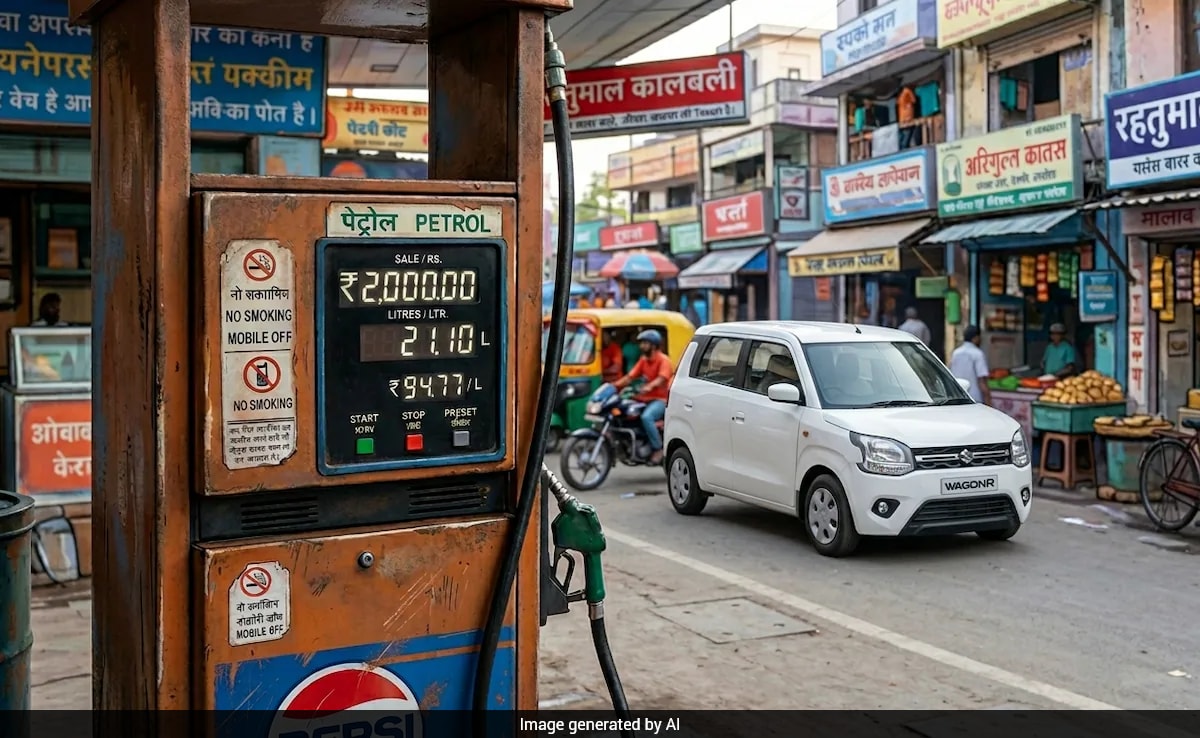
When you pull into a petrol station and hand over a 2,000 rupee note, you aren't just buying fuel. You are unknowingly funding a massive, intricate machinery of state revenue, debt servicing, and geopolitical balancing acts. Only about half of that money actually pays for the combustible liquid entering your tank. The rest vanishes into a black box of central levies, state VAT, and dealer commissions. While global crude prices fluctuate based on storms in the Gulf or production cuts in Riyadh, the price at the Indian pump remains remarkably stubborn. This isn't an accident of the market. It is a deliberate fiscal strategy that has turned the common motorist into the primary financier of the Indian exchequer.
The math is brutal. Out of every 2,000 rupees spent, the actual cost of the petrol—the "base price" that includes the cost of the crude oil and the refinery's processing fee—sits somewhere between 1,000 and 1,100 rupees depending on the daily exchange rate and global benchmarks. The remaining 900 to 1,000 rupees is a stack of taxes. To understand why this happens, one must look past the simple explanation of "high taxes" and into the structural dependency the government has developed on fuel.
The Tax Trap
The central government and state governments are locked in a silent struggle over your fuel money. Unlike most goods in India, petrol and diesel are excluded from the Goods and Services Tax (GST). This exclusion is the single biggest reason for the price disparity across different cities. If petrol were under a 28% GST—the highest slab—prices would crash overnight. However, neither the Center nor the States will allow this.
For the Center, the Excise Duty on fuel is a predictable stream of cash that doesn't have to be shared entirely with the states. By labeling parts of the tax as "cess" or "surcharge," the Union government can keep the lion’s share for specific infrastructure projects or debt repayments. On the other side, states rely on Value Added Tax (VAT) as one of their few remaining independent revenue levers. When a state needs to fund a new welfare scheme or bridge a budget deficit, they don't look to income tax; they nudge the VAT on fuel upward by a percentage point.
This creates a floor for prices. Even if the global price of Brent crude were to drop significantly, the consumer rarely feels the full benefit. The government often uses those moments to "absorb" the savings by increasing the excise duty, effectively keeping the pump price stable while padding the treasury. It is a one-way valve: prices rise when crude goes up, but they plateau when crude goes down.
The Iran Equation and Global Friction
The supply side is equally convoluted. For years, India benefited from a "special relationship" with Iran, which provided cheap crude, extended credit windows, and even accepted payment in rupees. This arrangement bypassed the US dollar-dominated global trade system and kept Indian refineries healthy. But under pressure from international sanctions, those taps were largely turned off.
Replacing Iranian crude wasn't just about finding a new seller; it was about shifting the entire logistics chain. Crude from Iraq, Saudi Arabia, and more recently, Russia, comes with different "grades" and transportation costs. When India began importing massive quantities of Russian Urals following the 2022 geopolitical shifts, the narrative was that "cheap Russian oil" would lower prices for the common man.
The reality was different. While Indian refiners—both state-owned and private—bought Russian crude at a discount, that discount didn't trickle down to the 2,000 rupees you spend. Instead, the refiners used the margin to shore up their own balance sheets or offset previous losses incurred when they held prices steady during election cycles. You are paying for the refinery's past losses and the state's future projects every time you click the nozzle.
The Invisible Middleman
We often blame the "oil companies" as a monolithic entity, but the three state-run giants—Indian Oil, Bharat Petroleum, and Hindustan Petroleum—operate under a unique set of constraints. They are theoretically autonomous, yet they take "cues" from the Ministry of Petroleum on when to freeze prices. This usually happens in the months leading up to major state or national elections.
During these freezes, the companies may actually lose money on every liter sold. To recover, they must keep prices high even when global markets suggest a price cut is due. This "under-recovery" cycle means the Indian consumer is never paying the current market price; they are always paying a price that accounts for political timing and corporate recovery.
Then there is the dealer's commission. While it is a relatively small portion of your 2,000 rupees—around 70 to 80 rupees for the petrol pumps—this commission is the primary income for tens of thousands of gas station owners. Their margins are fixed, meaning they don't necessarily profit more when prices go up, but they do have to deal with the operational costs of storing and distributing the fuel safely.
The Inflationary Impact
The hidden story of your fuel bill is its "pass-through" effect. While 2,000 rupees covers the fuel in your car, it also dictates the price of the vegetables in your fridge. The vast majority of Indian freight moves on trucks. When diesel and petrol prices are kept artificially high to balance the government's books, transportation costs surge.
This isn't a linear increase. A 5% rise in fuel costs can lead to a 10% rise in the price of onions or wheat, as every layer of the supply chain adds its own margin to cover the extra transport bill. This is the "tax on tax" effect. The government collects the excise duty, and then the common man pays higher prices on everything else because of that duty.
Ultimately, the structure of your 2,000 rupee fuel bill is a testament to India's fiscal dependence on petroleum. Until there is a seismic shift in how the country generates revenue—or a move toward GST inclusion—the pump will remain a tax collection agency disguised as a gas station.