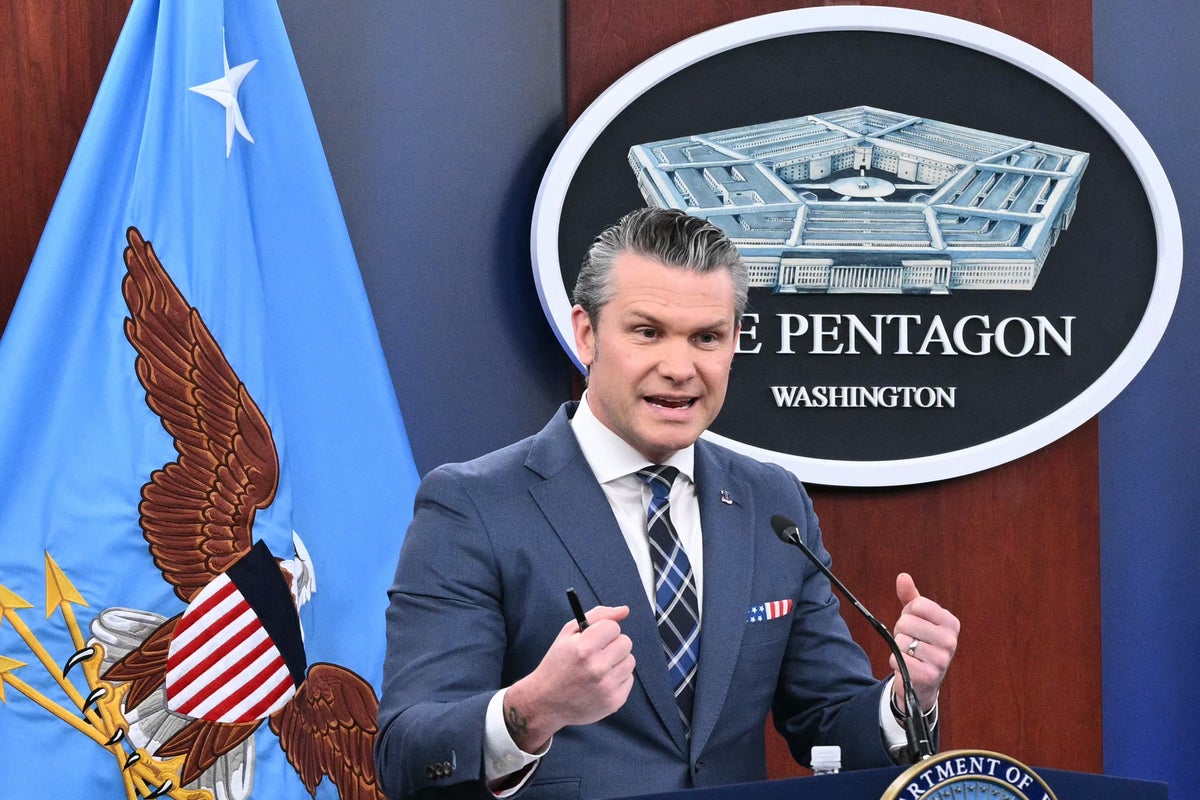
The operational doctrine governing American military posturing toward Iran rests on the friction between troop presence as a deterrent and troop presence as a liability. When executive leadership asserts a refusal to deploy ground forces while simultaneously refusing to disclose hypothetical deployment strategies, they are not merely obfuscating; they are employing Strategic Ambiguity. This framework serves as a psychological multiplier intended to complicate the adversary’s "cost-benefit" calculus. By removing the certainty of a specific kinetic response, the United States forces Iranian strategic planners to prepare for a spectrum of contingencies rather than a singular, predictable outcome.
The Calculus of Kinetic Restraint
Direct military intervention in the Iranian theater involves a specific cost function that traditional political rhetoric often ignores. Unlike previous conflicts in the region, the geography of Iran—defined by the Zagros and Alborz mountain ranges—creates a natural defensive perimeter that necessitates a massive logistical footprint for any sustained ground operation.
The decision to state "I'm not putting troops anywhere" functions as a signal of Economic and Political Prioritization. Modern warfare has shifted toward standoff capabilities—unmanned aerial vehicles (UAVs), cyber-operations, and long-range precision strikes—which allow for the projection of power without the domestic political fallout of "boots on the ground."
The Three Pillars of Non-Disclosure
- Informational Asymmetry: If an administration defines the "Red Lines" or specific troop thresholds for intervention, the adversary can operate just beneath that threshold with impunity. By stating that they "certainly wouldn’t tell you" if they were deploying, the U.S. maintains an informational edge that prevents Iran from optimizing its asymmetric proxy networks (such as Hezbollah or the Houthis).
- Operational Flexibility: Pre-announcing troop movements subjects the military to rigid timelines and public scrutiny. Maintaining silence preserves the ability to pivot from a "Maximum Pressure" economic campaign to a "Rapid Deployment" kinetic campaign without the lag time of public debate.
- Domestic De-escalation: Publicly committing to "no troops" satisfies a war-weary domestic electorate, while the refusal to rule them out entirely retains the credibility of the Commander-in-Chief’s "Total Force" options.
The Mechanics of Standoff Deterrence
The assertion that troops are not currently being deployed does not imply a vacuum of power. Instead, it reflects a transition toward Integrated Deterrence. This model relies on three distinct technological and strategic layers that replace the need for traditional infantry divisions.
The Maritime Chokepoint Variable
The Strait of Hormuz remains the primary pressure point in the Iran-U.S. relationship. Roughly 20% of the world's total oil consumption passes through this waterway. Any troop deployment logic must account for the Hormuz Dilemma:
- A heavy naval presence protects tankers but provides a target for Iranian "swarm" boat tactics and anti-ship cruise missiles (ASCMs).
- A light presence reduces target opportunity but emboldens Iranian maritime interdiction.
The strategic preference for "not telling" the public about deployment details specifically protects the location and readiness of Carrier Strike Groups (CSGs) and Expeditionary Strike Groups (ESGs), which function as mobile, sovereign U.S. territory.
The Proxy Friction Model
Iran’s "Gray Zone" strategy utilizes third-party actors to execute kinetic strikes, allowing the central government in Tehran to maintain plausible deniability. The U.S. response to this—deterrence by denial—focuses on hardening regional infrastructure rather than flooding the zone with American soldiers. This shifts the burden of defense onto regional partners like Saudi Arabia and the UAE, supported by American technical expertise and intelligence sharing.
The Cost Function of Modern Ground Intervention
To understand why a refusal to deploy troops is a logical baseline, one must quantify the "Entry-Exit Friction" of the Iranian plateau. A standard armored division requires roughly 3,000 tons of supplies daily. In a theater as vast and topographically hostile as Iran, the logistical tail required to support a ground force would be vulnerable to asymmetric disruption at every node.
The Attrition Constant
Unlike the flat terrain of Iraq, Iran’s urban centers are located in high-altitude regions. This creates a significant Tactical Verticality advantage for defenders.
- Air Superiority Limitations: High-altitude operations reduce the effective payload and loiter time of strike aircraft.
- Urban Guerilla Dynamics: The Iranian Basij and IRGC are structured for decentralized resistance, meaning a conventional U.S. troop presence would face a perpetual state of low-intensity attrition.
By signaling a reluctance for ground deployment, the U.S. avoids the "Sunk Cost" trap where a military presence becomes the justification for its own continued existence, despite diminishing strategic returns.
Deconstructing the Rhetoric of Silence
The phrase "If I were [putting troops], I certainly wouldn’t tell you" is a masterpiece of Escalation Management. It creates a "Schrödinger’s Deployment" where the adversary must assume the worst-case scenario is always a possibility. This is a direct application of the Madman Theory, originally popularized during the Nixon administration, which posits that if an adversary believes a leader is unpredictable or willing to use disproportionate force, they will be more cautious in their provocations.
The Signaling Value of Uncertainty
In game theory, a "Cheap Talk" signal is one that costs nothing to send and carries no binding commitment. However, when a leader combines "Cheap Talk" (I'm not putting troops there) with a "Hidden Variable" (but I wouldn't tell you if I did), it transforms the statement into a Credible Threat. The uncertainty itself becomes the deterrent.
The second limitation of this strategy is the risk of "Accidental Escalation." If the adversary misinterprets the silence as a green light for aggression, they may cross a threshold that forces the U.S. into a kinetic response it was hoping to avoid. This creates a bottleneck in diplomatic channels where the lack of clear "Off-Ramps" can lead to a rapid spiral into full-scale conflict.
The Technological Pivot: Deterrence Without Presence
The modern "No Troops" stance is enabled by the maturity of the Remote Warfare Stack. This stack consists of three primary components that provide the same influence as a ground division with significantly lower risk profiles:
- SIGINT (Signals Intelligence): The ability to monitor Iranian command and control in real-time allows for "Left of Launch" interventions—disrupting an attack before it begins through cyber-means.
- UCAVs (Unmanned Combat Aerial Vehicles): Platforms like the MQ-9 Reaper provide persistent surveillance and strike capability. They are politically "disposable," meaning their loss does not trigger the same domestic pressure for war as the death or capture of a soldier.
- Financial Sanctions as Kinetic Tools: The "Weaponization of the Dollar" serves as a continuous, non-kinetic bombardment of the Iranian economy. By restricting the IRGC’s access to global capital, the U.S. degrades their ability to fund proxy operations more effectively than a localized infantry engagement could.
Strategic Forecasting
The convergence of these factors suggests that U.S. policy will continue to oscillate between overt isolationism and covert readiness. The refusal to define the parameters of military intervention is a calculated move to preserve "Maximum Optionality."
For the private sector and global markets, this means the Geopolitical Risk Premium on oil will remain volatile. The lack of a clear "Peace Treaty" or "War Declaration" keeps the region in a state of permanent "No-War, No-Peace."
The optimal strategy for the U.S. moving forward is the continued development of Autonomous Deterrence Systems. By increasing the density of unmanned underwater vehicles (UUVs) in the Persian Gulf and expanding the reach of cyber-offensive units, the U.S. can maintain its "No Troops" pledge while simultaneously tightening the strategic noose around Iranian maritime and nuclear ambitions. The goal is not the conquest of territory, but the total neutralization of the adversary’s ability to project power beyond their own borders.
Establish a permanent, automated surveillance corridor in the Strait of Hormuz using a mix of sub-surface and aerial drones. This provides the "Hidden" deployment capability alluded to in executive rhetoric, ensuring that while troops are not "put anywhere," American influence remains omnipresent and technologically unassailable.