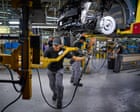
Nissan’s Sunderland plant is the crown jewel of British automotive manufacturing, but it currently sits at the center of a geopolitical tug-of-war that could dismantle thirty years of industrial progress. The threat is specific. If the United Kingdom is excluded from the evolving "Made in Europe" rules of origin, the economic logic of building cars in the North East evaporates. This isn't just corporate posturing or a request for more subsidies. It is a fundamental calculation of math versus geography.
The automotive industry operates on razor-thin margins. When those margins are hit by a 10% tariff because a battery was made in the wrong jurisdiction, the factory ceases to be an asset and becomes a liability. Sunderland produces hundreds of thousands of vehicles annually, including the Qashqai and Juke. However, the shift to electric vehicles (EVs) has changed the nature of what a "British" car actually is. If the batteries—the most expensive component of an EV—don't meet strict local content requirements shared with the European Union, the entire export model collapses. For a deeper dive into this area, we suggest: this related article.
The Mathematical Trap of Rules of Origin
To understand why Nissan is sounding the alarm, you have to look at the Trade and Cooperation Agreement (TCA). This document dictates how much of a car must be produced within the UK or EU to avoid heavy taxes when crossing the English Channel. For decades, internal combustion engines were easy to source locally. The transition to electric power flipped the script.
A battery pack can account for nearly 40% of a vehicle's total value. Under the current trajectory of "Made in Europe" mandates, if those cells are sourced from Asia, the car fails the "local content" test. The UK finds itself in a precarious middle ground. It is no longer part of the EU bloc, yet its supply chain is inextricably linked to it. If the EU tightens these rules to shut out Chinese competition—a primary goal of Brussels—the UK risks becoming collateral damage. For additional background on this development, extensive reporting can also be found at Financial Times.
The problem is one of accumulation. "Cumulation" allows parts from the EU to count as "local" in the UK and vice versa. If the EU decides to define "European" in a way that excludes British-made components or UK-assembled packs using non-EU cells, the Sunderland plant loses its primary market. 70% of Sunderland's output is destined for Europe. Take that away, and you are left with a massive facility producing for a domestic market that is nowhere near large enough to sustain it.
The Battery Giga-factory Race
Nissan isn't waiting for the British government to solve the problem with diplomacy alone. Their partnership with Envision AESC to build a giga-factory in Sunderland is an attempt to "homegrow" the solution. But building a factory is not the same as securing a supply chain. The raw materials—lithium, cobalt, nickel—still largely flow through processing hubs dominated by overseas interests.
The Myth of British Autonomy
There is a persistent narrative that the UK can forge its own path in the EV sector. This is a dangerous oversimplification. No modern car manufacturer is an island. The components for a single Nissan crossover might cross the Channel half a dozen times before the vehicle rolls off the line. When the UK government talks about "Global Britain," the automotive analysts in Tokyo see a map of logistical hurdles.
The Sunderland plant succeeded because it was the most efficient gateway to the European Single Market. Without that seamless integration, the efficiency of the workforce—which is legendary in the industry—cannot overcome the dead weight of a 10% tariff. Competitors in France, Germany, and Spain are watching. Every friction point created by UK-EU regulatory divergence is an invitation for investment to migrate to the mainland.
Why the EU Rules are Hardening
The hardening of "Made in Europe" rules isn't specifically aimed at hurting the UK. It is a defensive crouch against China. The European Commission is terrified that Chinese manufacturers will use "screwdriver plants" in neighboring countries to circumvent tariffs and flood the market with cheap EVs. By demanding high levels of local value-add, the EU is trying to force the entire supply chain to relocate to European soil.
The UK's dilemma is that it must match these requirements or be locked out. However, matching them requires a level of industrial strategy that has been inconsistent in Westminster. While the US uses the Inflation Reduction Act to throw hundreds of billions at green tech, and the EU responds with its own Green Deal Industrial Plan, the UK has often relied on one-off grants and "deals" with individual companies. Nissan is signaling that the era of the "one-off deal" is over. They need structural certainty.
The Sunderland Ripple Effect
If Sunderland were to downsize or close, the impact would extend far beyond the 6,000 people employed directly by Nissan. The "Tier 1" and "Tier 2" suppliers—the companies making the seats, the plastics, the wiring harnesses—are concentrated in the North East. We are talking about an ecosystem of 30,000 jobs.
Sunderland is often cited as a post-industrial success story, a city that reinvented itself after the decline of shipbuilding and coal. Losing the plant would be more than an economic hit; it would be a psychological catastrophe for the region. The UK government knows this, which is why the rhetoric from Nissan is so effective. It is the ultimate leverage.
The Cost of Divergence
Every time the UK deviates from EU standards—whether on chemicals, labor laws, or environmental reporting—it adds a layer of complexity for manufacturers. For a company like Nissan, which operates on a "just-in-time" delivery model, complexity is a cost. If a part is held up at customs for three hours because of a paperwork mismatch, the assembly line stops. A stopped line costs thousands of pounds per minute.
The demand for "Made in Europe" inclusion is a demand for a common regulatory zone. It is an admission that, for the automotive sector, Brexit is an ongoing process of damage limitation rather than an opportunity for radical departure. The "Red Wall" politics of the UK further complicate this. The very voters who supported leaving the EU are often the ones whose livelihoods depend on the UK remaining as close to the EU's industrial orbit as possible.
The Strategy of the Ultimatum
Is Nissan actually going to leave? In the short term, no. They have invested too much in the "EV36Zero" hub. But the automotive industry doesn't think in fiscal quarters; it thinks in seven-year vehicle lifecycles. Decisions about where the next generation of cars will be built are being made today. If the "Made in Europe" rules are not settled in the UK's favor within the next 18 to 24 months, the investment for the 2030s will go elsewhere.
Nissan’s leadership is playing a high-stakes game of chicken with both London and Brussels. They are telling the UK government: "Fix the diplomacy." They are telling the EU: "Don't lock us out of the ecosystem we helped build."
Energy Costs and the Hidden Tax
Beyond the rules of origin, there is the quiet killer of UK manufacturing: energy prices. It takes a massive amount of electricity to manufacture batteries. UK industrial energy prices have historically been higher than those in France or Germany. When you add the potential for tariffs to the already high cost of power, the "Sunderland Advantage" disappears.
The plant has attempted to mitigate this with its own wind and solar farms, but a factory of that scale cannot run on weather-dependent microgeneration alone. It needs a stable, cheap national grid. If the UK cannot provide a competitive energy environment, even the most favorable rules of origin won't save the plant in the long run.
A Question of Industrial Survival
The situation at Sunderland is a microcosm of the UK's broader struggle to find its place in a fractured global economy. The era of free trade is being replaced by an era of "friend-shoring" and protectionism. In this new world, being a medium-sized economy floating off the coast of a massive trading bloc is a dangerous position to be in.
The UK must convince the EU that a strong British automotive sector is a benefit to the continent, acting as a bulwark against external competition rather than a backdoor for it. This requires a level of diplomatic finesse that has been in short supply. If the UK is excluded from the European rules, it won't just be Nissan that suffers. It will be the signal that the UK is no longer a viable place for complex, high-value manufacturing.
The government needs to move beyond the rhetoric of "world-leading" ambitions and engage with the granular, boring, and vital details of customs codes and value-added percentages. This is where the future of the British car industry will be decided—not in a press release, but in a windowless room in Brussels where the definition of a "European" battery is written into law.
The clock is ticking on the next investment cycle, and the silence from the negotiators is the loudest sound in the Sunderland factory.
Check the current status of the UK-EU specialized committee on rules of origin to see if a technical solution is being drafted.