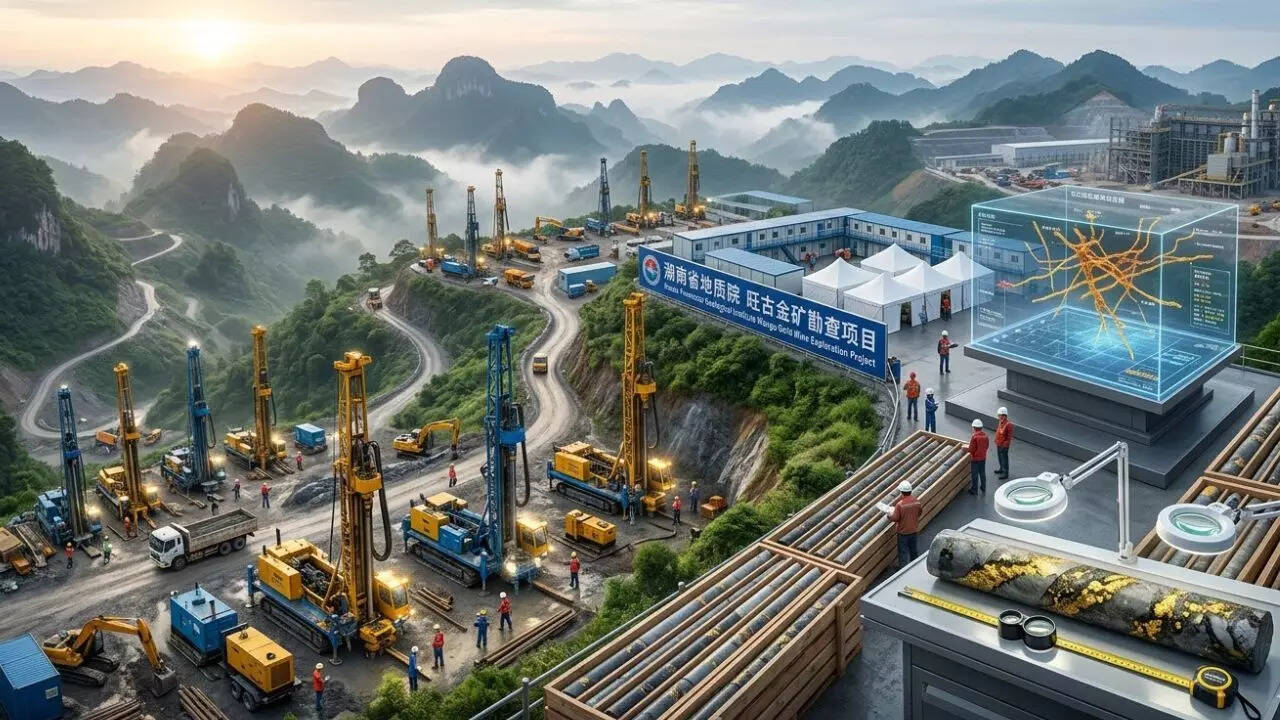
The discovery of the Wangu gold field in central China’s Hunan Province, estimated to contain over 1,000 tonnes of gold across 40 distinct veins, represents a geological anomaly that disrupts standard mineral scarcity models. Valued at approximately $83 billion at current market spot prices, the find is classified as a "supergiant" deposit. However, the raw valuation of in-situ ore is a deceptive metric. The true economic impact of the Wangu discovery depends on the intersection of three critical variables: the structural continuity of the ore bodies, the depth-to-extraction cost ratio, and the metallurgical recovery efficiency required to move from speculative resource to proven reserve.
The Structural Mechanics of the Wangu Field
Geological surveys indicate that the Wangu deposit is characterized by high-grade ore situated at extreme depths, with some veins extending beyond 3,000 meters. In gold mining, the transition from shallow-pit operations to ultra-deep underground mining triggers an exponential increase in capital expenditure (CAPEX) and operational expenditure (OPEX).
The deposit's architecture follows a classic orogenic gold model, where mineralized fluids are injected into crustal fault zones during tectonic events. At Wangu, the primary value driver is the "strike-length" and the "vertical extent" of these veins. While a 1,000-tonne estimate suggests a massive aggregate volume, the economic viability is dictated by the density of the gold within the rock, measured in grams per tonne (g/t). High-grade "bonanza" zones can offset the costs of deep-shaft cooling and ventilation, whereas low-grade disseminated gold at 2,000 meters often remains stranded regardless of the total tonnage.
The Three Pillars of Resource Viability
To understand why a $83 billion valuation is a starting point rather than a final figure, we must apply a feasibility framework:
- Geological Certainty (The Confidence Gradient): The 1,000-tonne figure likely combines "measured," "indicated," and "inferred" resources. Measured resources have high geological certainty, while inferred resources are based on limited sampling and geological projections. The market must distinguish between gold that is "there" and gold that can be "mapped for extraction."
- The Depth-Cost Inflection Point: Once mining exceeds 1,500 meters, energy requirements for hoisting ore and pumping water increase non-linearly. The Wangu field’s depth suggests it will require advanced automated drilling and seismic monitoring to maintain safety and profitability.
- Metallurgical Complexity: Gold is rarely found in isolation. If the Wangu gold is "refractory"—locked within sulfide minerals like pyrite or arsenopyrite—it requires complex processing such as roasting or pressure oxidation. These processes add significant cost per ounce, narrowing the margin between the spot price and the All-In Sustaining Cost (AISC).
Supply Dynamics and the Scarcity Myth
The addition of 1,000 tonnes to global gold inventories sounds like a market-destabilizing event, yet it represents roughly 0.5% of the total gold ever mined (approximately 210,000 tonnes). The impact on global supply is buffered by the time-to-market lag.
A discovery of this magnitude does not hit the market simultaneously. The development cycle for a supergiant mine typically spans 10 to 15 years from discovery to first pour. This delay is caused by the "Bottleneck of Scaling," where environmental permits, infrastructure development (power grids and water management), and shaft sinking create a natural throttle on supply.
The Cost Function of Extraction
A fundamental economic principle in mining is that the lowest-cost ounces are extracted first. In the case of the Wangu field, the initial 400 tonnes found at depths above 2,000 meters represent the "Primary Tier" of the project. The remaining 600 tonnes, located at deeper stratas, constitute the "Secondary Tier."
The AISC for these tiers will likely diverge:
- Tier 1 (Shallow): Estimated AISC of $800–$1,100 per ounce, benefiting from existing infrastructure and lower thermal gradients.
- Tier 2 (Ultra-Deep): Estimated AISC of $1,400–$1,700 per ounce, where the cost of human safety and mechanical durability in high-pressure environments begins to erode the $2,600+ spot price advantage.
Strategic Implications for Global Gold Sovereignty
The Wangu discovery reinforces China's position as the world's leading gold producer, a title it has held for over a decade. However, the strategic value is less about the $83 billion in currency and more about the "Internal Reserve Buffer."
China has been a net importer of gold despite its massive domestic production. By tapping into supergiant deposits like Wangu, the state reduces its dependence on the London and New York markets for physical settlement. This creates a closed-loop gold economy where domestic extraction feeds the central bank’s reserves without putting upward pressure on international prices or draining foreign currency reserves.
Geopolitical Leverage and Central Bank Reserves
The "Gold-to-GDP" ratio is an informal metric used by analysts to judge a nation's economic resilience against currency devaluation. For China, increasing domestic supply through the Wangu field allows for a stealthy diversification of the People's Bank of China (PBoC) balance sheet.
- Mechanism 1: Sanction Insulation. Physical gold held within national borders is immune to overseas freezing or seizure.
- Mechanism 2: Currency Backing. While no major currency is on a gold standard, high domestic gold reserves increase the perceived stability of the Yuan in international trade settlements.
Technological Requirements for Ultra-Deep Mining
The Wangu field will serve as a laboratory for the next generation of mining technology. To extract gold at 3,000 meters, the operation must solve the "Thermal Barrier." Rock temperatures at these depths can exceed 50°C (122°F), making human labor impossible without massive refrigeration plants.
The shift toward Autonomous Extraction Systems is the only logical path forward. This involves:
- Tele-Remote Operation: Using 5G-enabled machinery controlled from the surface to remove personnel from high-risk, high-heat zones.
- Precision Blasting: Utilizing AI-driven seismic modeling to minimize "dilution"—the accidental mining of waste rock along with the gold vein.
- Ore-Sorting Sensors: Deploying X-ray transmission (XRT) technology at the face of the mine to immediately identify high-grade ore, reducing the energy wasted on transporting worthless rock to the surface.
Constraints and Market Realities
Every supergiant deposit faces a "Diminishing Return on Discovery." The headline figure of 1,000 tonnes assumes 100% recovery, which is physically impossible. Current global averages for recovery rates in underground gold mines fluctuate between 85% and 95%.
The second limitation is the "Environmental Ceiling." Hunan Province is a significant agricultural and industrial hub. The Wangu field will produce millions of tonnes of "tailings"—the waste byproduct of gold processing. Managing these tailings without contaminating local groundwater or the Xiang River system represents a significant hidden cost that is rarely factored into the $83 billion "treasure" narrative.
Furthermore, the "Incentive Price" must be considered. While gold prices are currently high, a significant market correction during the 10-year development phase could render the ultra-deep portions of Wangu economically stranded. The project requires a sustained price floor to justify the multi-billion dollar CAPEX of deep-shaft construction.
Strategic Recommendation for Resource Investors
The Wangu discovery confirms that the era of "easy gold" is over, replaced by the era of "technical gold." Analysts should move away from gross tonnage as a primary metric and focus on the Margin per Vertical Meter.
The strategic play is to monitor the procurement of high-tech mining equipment and cooling infrastructure by the operators of the Wangu field. The true value of this find will not be realized in a sudden influx of bullion, but in the incremental strengthening of domestic supply chains and the advancement of deep-crust extraction capabilities. Investors should treat the $83 billion figure as a theoretical maximum, adjusting for a 15% metallurgical loss and a 30% deep-vein extraction penalty. The focus must remain on the deployment of automated systems, as these will be the ultimate arbiters of whether the Wangu gold is an accessible asset or a permanent geological curiosity.