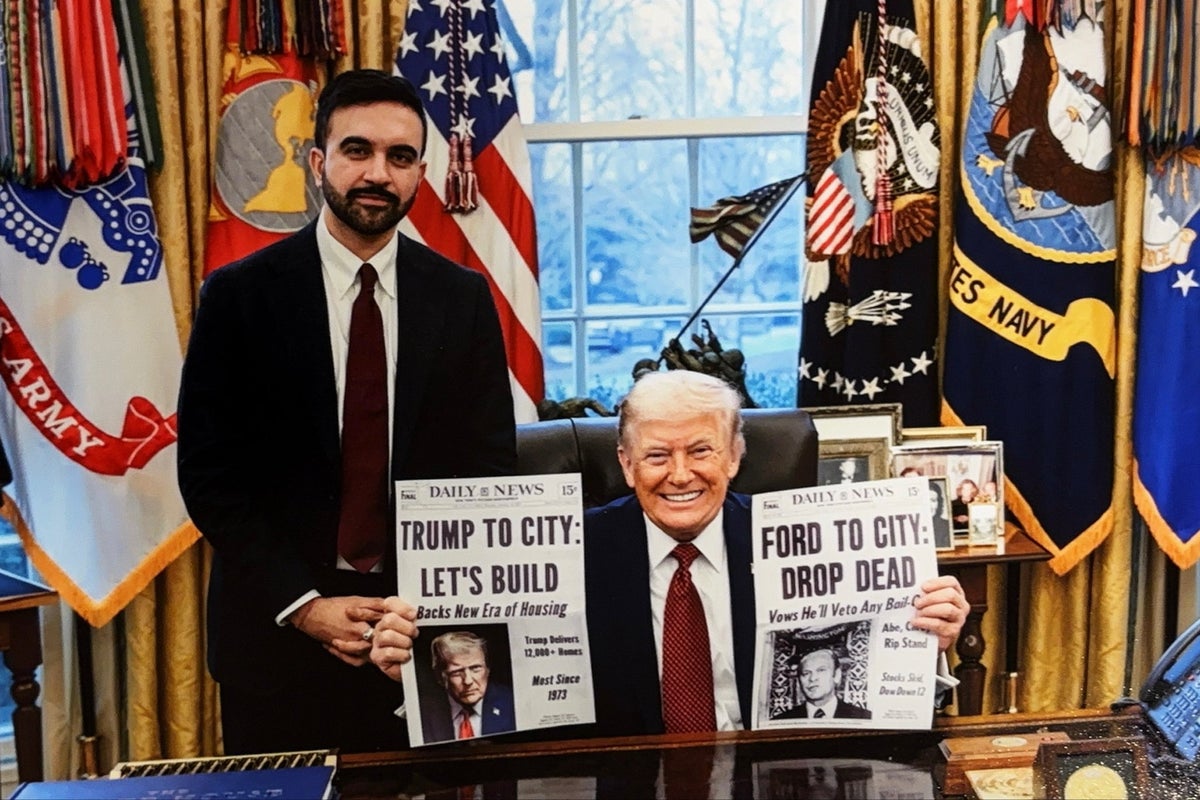
The viral photograph of New York State Assemblyman Zohran Mamdani alongside Donald Trump at the White House is not a lapse in branding but a calculated execution of a high-variance political trade. In the current polarized environment, the "cost of optics" often prevents legislators from engaging in cross-partisan diplomacy. However, for a democratic socialist whose platform relies on shifting the Overton Window, the marginal utility of a direct audience with the Executive Branch outweighs the temporary depreciation of social capital within an insular base. To analyze this event accurately, one must look past the aesthetic of the encounter and dissect the underlying game theory of legislative advocacy under an adversarial administration.
The Tripartite Framework of Political Engagement
Every high-profile interaction between ideological opposites can be categorized by three distinct structural drivers. Mamdani's visit was not a social call but a deployment of these specific mechanisms: Discover more on a connected subject: this related article.
- The Information Asymmetry Arbitrage: Legislative actors often possess localized data (e.g., housing crises in Astoria, specific infrastructure bottlenecks) that the federal executive branch lacks or ignores. Direct access allows a representative to inject these data points into the executive's decision-making loop, bypassing the filtration of mid-level staffers.
- The Sovereignty of Presence: In a digital-first political economy, physical presence remains the only un-hackable form of influence. By occupying the same physical space as the President, a state-level official forces a recognition of their constituency's existence, a tactic Mamdani has previously utilized in hunger strikes and labor pickets.
- The Legitimacy Exchange: While the critic sees "normalization," the practitioner sees "validation." Securing a seat at the table—regardless of who owns the table—signals to stakeholders and donors that the representative has reached a tier of influence where they are no longer ignorable.
Calculating the Optical Discount Rate
The backlash against Mamdani stems from a failure to account for the Optical Discount Rate (ODR). This is the degree to which a politician is willing to let their public approval rating drop in the short term to secure a long-term policy objective.
For Mamdani, the ODR is unusually high. Because he represents a deep-blue district with a secure mandate, he can afford a 15% dip in favorability among "purist" voters if that transaction results in a specific federal concession or a shift in the national conversation regarding his core issues—namely housing rights and international human rights. Additional analysis by Reuters delves into comparable views on this issue.
The risk is not total; it is compartmentalized. The "Trump photo" serves as a lightning rod for the opposition, but for the pragmatist, it is the entry fee for the meeting. The mistake made by superficial analysts is treating the photo as the output of the meeting, rather than the overhead cost of the meeting.
The Bottleneck of Decentralized Advocacy
Mamdani’s defense of the visit highlights a chronic bottleneck in modern activism: the transition from protest to policy.
- Phase 1: Agitation: Building enough public pressure to be noticed.
- Phase 2: Access: Converting that pressure into a literal meeting.
- Phase 3: Application: Presenting specific, actionable demands within that meeting.
Most political actors stall at Phase 1. They fear that moving to Phase 2 will be interpreted as a betrayal of the movement's purity. Mamdani’s decision to attend the White House event indicates a strategic bet that his movement has reached a maturity level where it can survive the "contamination" of high-level engagement. If the goal is to influence federal policy on the Middle East or urban development, the path through the White House—even a Republican one—is the only path that bypasses the friction of standard legislative gridlock.
Structural Incentives for the Viral Outcry
The "viral" nature of the photo is a byproduct of the Conflict-Engagement Loop. Social media algorithms are optimized to prioritize content that triggers moral outrage.
- The Left-Wing Incentive: To maintain "revolutionary" credentials, influencers within the progressive sphere must denounce any proximity to Trump. This creates a feedback loop where the loudest voices are those least interested in the nuances of executive lobbying.
- The Right-Wing Incentive: For the Trump administration, the photo serves as a tool for "triangulation." By showing a radical leftist in the White House, they signal a willingness to talk to anyone, which softens their image for moderate voters while simultaneously sowing discord within the Democratic coalition.
This creates a scenario where both extremes benefit from the controversy, while the actual substance of the conversation—the policy points Mamdani reportedly brought to the table—is suppressed.
The Opportunity Cost of Absence
The strongest argument for Mamdani’s attendance lies in the Cost of the Empty Chair. In political science, the "empty chair" theory posits that if a specific viewpoint is not represented in the room, the resulting policy will be optimized entirely for the parties who did show up.
If Mamdani had declined the invitation, the space would not have remained empty. It would have been filled by a more moderate or conservative actor who would not have challenged the President’s assumptions on housing or foreign policy. By choosing to be the "radical in the room," Mamdani ensures that the executive branch is forced to hear a discordant note. This is the difference between protesting a system and stress-testing it from within.
Tactical Limitations and Systemic Friction
Despite the strategic logic, this approach has hard ceilings. The "Insider-Outsider" strategy only works if the "Insider" (Mamdani) retains enough "Outsider" credibility to mobilize his base for the next election.
- The Dilution of Message: Every time a radical meets with a status-quo figure, their core message is slightly sanded down to fit the context of the meeting.
- The Asymmetry of Power: Trump, as President, holds significantly more leverage. He can use the meeting for a five-minute photo op and then ignore every single policy brief Mamdani provides. In this scenario, Mamdani pays the optical price but receives zero policy dividends.
- The Base Erosion: If the "purist" wing of the Democratic Socialists of America (DSA) decides that this is a red-line violation, Mamdani risks a primary challenge from his own left flank.
Strategic Recommendation for Policy Disruptors
For political actors operating in Mamdani’s position, the strategy moving forward should be one of Documented Demands. To mitigate the optical risk, the meeting must be followed by a transparent, high-density release of exactly what was proposed.
The play is not to apologize for the photo, but to weaponize it. The photo becomes the "hook" that draws the public into a much more technical discussion about federal grants, executive orders, or legislative amendments. If the representative can prove that the 30 seconds spent taking a photo led to a 30-minute discussion on a critical policy lever, the "betrayal" narrative collapses under the weight of tangible utility.
Mamdani’s defense suggests he understands this. He isn't asking for forgiveness for the proximity; he is asserting that his presence is a tool of the movement. The success of this gambit will be measured not by the number of likes on the viral photo, but by the specific language shifts in future executive actions or the introduction of collaborative bills that would have been impossible without that initial contact.
The strategic play now is to pivot from the "Why were you there?" defense to a "What did we get?" offensive. If no tangible gains are reported within a six-month window, the critics' "normalization" argument wins by default. If, however, a policy bottleneck is cleared, Mamdani will have provided a blueprint for how radical legislators can navigate a hostile federal environment without losing their foundational identity.